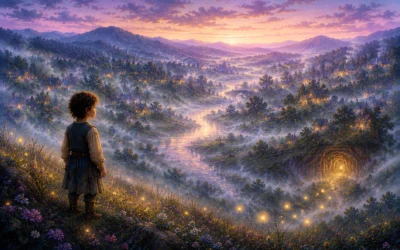

Everything has gone grey—the trees, the faces, even laughter itself. When Nimue meets a mysterious woman on an old stone bridge, she receives a paintbrush with no paint and a strange instruction: “Paint something true.” What begins as one girl’s journey to restore color becomes a discovery that the world isn’t made—it’s being made, every moment, by those brave enough to truly see. A wisdom story about attention, truth, and the power we forget we’re holding.
Nimue woke to grey.
Not the grey of storm clouds or winter mornings. Not the grey that promises rain or snow or something coming. Just… grey. The kind that meant nothing was coming at all.
Her room was grey. The window showed grey sky over grey trees over grey grass. She went downstairs. Grey kitchen. Grey toast. Her mother moved through it like a shadow through smoke, and when Nimue asked, “Is everything okay?” her mother said, “Of course, sweetheart,” in a voice the color of fog.
At school, the hallways were grey. The lockers. The faces. Even laughter sounded muted, like someone had turned down the volume on the world.
By lunch, Nimue couldn’t take it anymore. She walked out the side door—no one stopped her, no one even looked—and kept walking until the school disappeared behind grey trees.
She found herself at the edge of the woods, where an old stone bridge crossed a creek that had forgotten how to move. And there, sitting on the bridge rail with her legs dangling over the water, was a woman.
Not old, exactly. Not young either. She wore a coat patched with squares of fabric that almost had color—like someone had tried to dye them once and given up halfway through.
“Lost?” the woman asked.
“No,” Nimue said. “Just… everything’s grey.”
“Ah.” The woman nodded. “You’ve noticed.”
“Noticed what?”
“That the world is unfinished.”
Nimue blinked. “What?”
The woman hopped down from the rail, surprisingly nimble. Up close, Nimue could see her eyes—the only thing that wasn’t grey. They were the deep brown of wet earth, of tree bark after rain.
“The world isn’t made, child. It’s being made. Always. Every moment.” She reached into her coat and pulled out a paintbrush. Not a new one—the bristles were worn soft, the handle wrapped in faded cloth. She held it out. “Most people forget. They think they’re just walking through someone else’s painting. But that’s not how it works.”
Nimue stared at the brush. “I don’t understand.”
“You will.” The woman pressed it into Nimue’s hand. “Paint something true.”
“I’m not an artist. I don’t know how—”
“Good.” The woman smiled. It was the first real smile Nimue had seen in days. Weeks, maybe. “Then you won’t paint what you’ve been told to see. You’ll paint what’s actually there.”

Nimue stood alone on the bridge, holding a paintbrush with no paint.
This was ridiculous.
She turned to go back—and saw something. A small patch of green near the base of a tree. Just a few blades of grass, bright as spring.
She walked over. Knelt down. The grass was real. Solid. Not grey at all.
And then she saw: tiny footprints in the dirt around it. Her footprints. From where she’d walked.
She looked at the brush in her hand.
“Paint something true,” the woman had said.
Nimue thought about what was true. What was actually there, underneath all the grey.
She thought about her mother at breakfast—not the shadow-version, but the real one. The one who hummed while making coffee. Who left notes in Nimue’s lunch. Who was tired, yes, but trying.
Nimue closed her eyes and thought about that version of her mother. Held it in her mind like a photograph. Then she opened her eyes and looked at the grey grass in front of her.
She touched the brush to the ground.
Color spread like water through paper. Green, yes, but not just green—emerald and lime and the pale gold-green of new leaves. It rippled outward from where the brush touched, washing across the grass, up the tree trunk, into the branches.
Nimue gasped.
She stood up, heart hammering, and looked around. Most of the world was still grey. But that one tree blazed with life.
“Okay,” she whispered. “Okay.”
She went back to school.
The hallways were still grey, but now Nimue saw them differently. Not as finished things she had to accept, but as sketches. Drafts. Waiting.
In English class, Mr. Torres was handing back essays. His shoulders were slumped, grey, defeated. But Nimue remembered: last month he’d stopped class to read them a poem that made Sarah Chen cry—good crying. He’d said, “This is why words matter.” His voice had cracked when he said it.
That was true. That was what was actually there.
Nimue looked at him and thought about that moment. Held it. Then she squeezed the brush in her pocket—
Color bloomed across Mr. Torres’s shirt. Just a flash, like sunlight through leaves. He stood up straighter. When he smiled at them, it reached his eyes.
At lunch, Nimue sat with Rowan, who’d been eating alone since his best friend moved away. Rowan was grey all over—grey hoodie, grey face, grey silence.
Nimue didn’t know what to say. She wasn’t good at this kind of thing. But she knew what was true: Rowan was kind. He’d helped her pick up her books once when she dropped them. He’d said, “Happens to me all the time,” even though it probably didn’t, just to make her feel less stupid.
She thought about that. Held it.
Then she said, “Want to hear something weird?”
Rowan looked up. “Sure.”
“I think the world is broken,” Nimue said. “Like, genuinely broken. But I also think we can fix it. Not with hammers or whatever. With… I don’t know. Attention?”
Rowan was quiet for a long time. Then color crept into his hoodie—dark blue, like deep water. “That’s not weird,” he said. “That’s just true.”
It didn’t happen all at once.
Some days Nimue forgot. She’d walk through the grey and feel small and powerless and stupid for ever thinking a paintbrush without paint could do anything.
But then she’d see a patch of color somewhere—a tree she’d noticed, a person she’d really looked at—and she’d remember.
The woman on the bridge had said: Paint something true.
Not something pretty. Not something easy.
True.
So when Nimue’s mother sat at the kitchen table with her head in her hands, Nimue didn’t paint over it with false cheerfulness. She sat down next to her. She said, “I see you trying.”
Color spread across the table. Warm honey-gold.
Her mother looked up. “What?”
“I see you,” Nimue said again. “I see how hard you’re trying.”
Her mother’s eyes filled with tears. But they weren’t grey tears. They were clear as glass, bright as rain.
Three months later, Nimue walked back to the bridge.
The world wasn’t finished. It was still mostly sketch, still mostly waiting. But there were more colors now. Patches of them everywhere—in her neighborhood, at school, in the spaces between people who’d remembered how to really see each other.
The woman was sitting on the bridge rail again, legs dangling.
“I have questions,” Nimue said.
“Of course you do.”
“Who are you?”
The woman smiled. “I’m the part of you that knew before you did.”
“Knew what?”
“That you weren’t powerless. That you never were.” She tilted her head. “Did you think I was real?”
“I… you’re talking to me right now.”
“Am I?” The woman’s eyes were bright. Kind. “Or are you just finally listening to yourself?”
Nimue looked down at the brush in her hand—the brush she’d been carrying for months now, tucked in her pocket, pressed against her palm.
She looked back up.
The woman was gone.
But the bridge was brilliant with color—ivy climbing the stones, water moving silver-bright below, the sky overhead torn open with blue.

Nimue understood.
She’d always been holding the brush. The woman had just helped her see it.
That night, Nimue stood at her bedroom window looking out at the world. Still unfinished. Still waiting. But less grey than it had been.
She thought about the woman’s words: Most people forget they’re not just walking through someone else’s painting.
She wouldn’t forget.
She touched the brush to the windowsill—and color spread like dawn, like the first brave crack in a long darkness.
There was so much work to do.
So much world to finish.
But Nimue wasn’t afraid anymore.
She was ready to paint.
THE END
Find Your Next Story
See our complete collection of early reader audio stories for bedtime
Follow us on Facebook