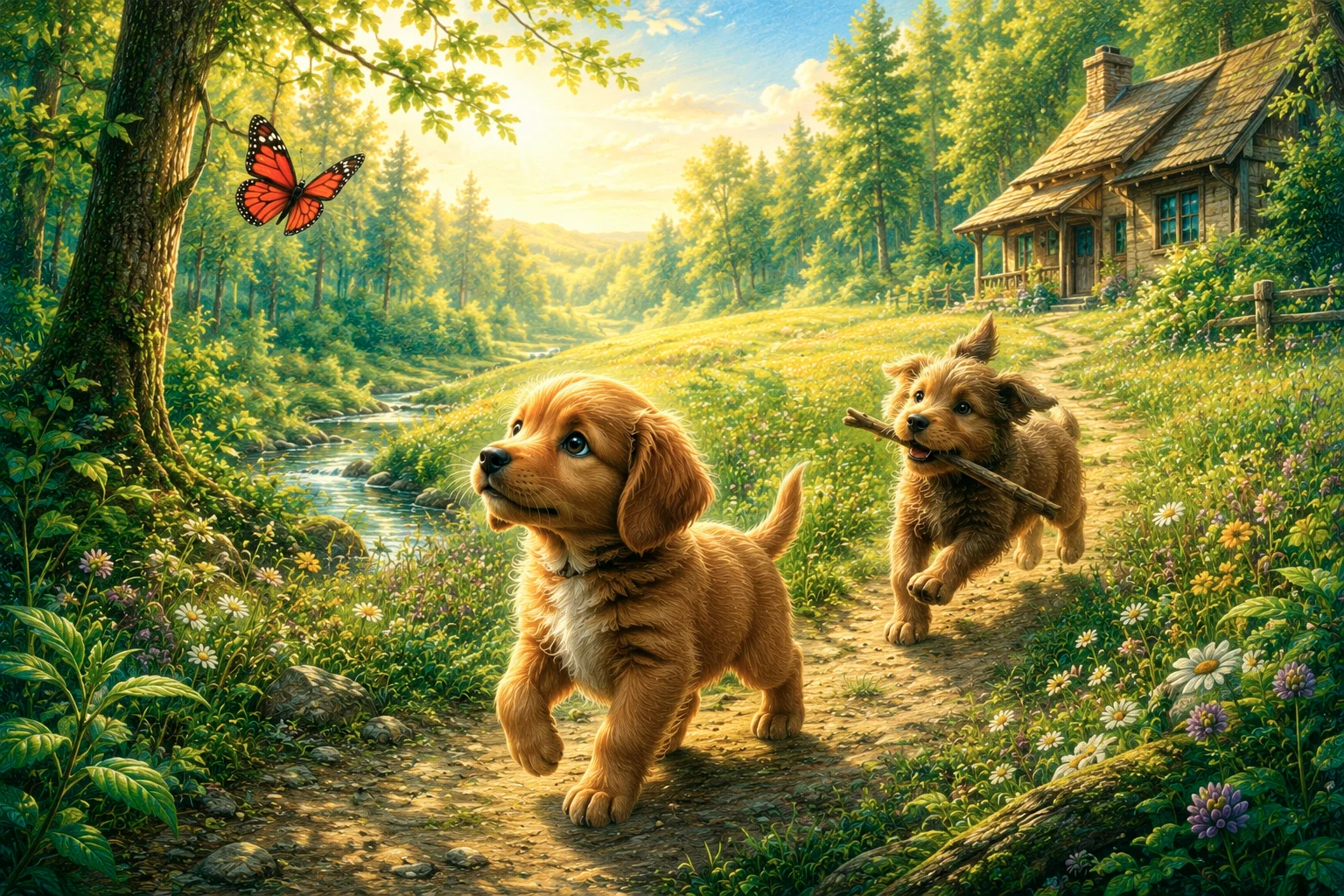
In a world of ticking clocks, a curious pup discovers a hidden glade where the rush of the day simply fades away. This is one of our most calming bedtime stories about dogs, perfect for helping little ones find the quiet moment within.
Chapter One: The Itch That Had No Name
Pippan had a problem he couldn’t explain.
It wasn’t a stomachache. It wasn’t a scraped paw. It wasn’t the kind of problem you could point to and say there — that’s the thing. It was more like the feeling you get when a song ends and the room goes quiet, and you can’t decide if the quiet is peaceful or wrong.
Everything around him was fine. More than fine.
His family was warm and close. The forest behind the meadow was full of good smells — pine and soil and something sweet near the old creek. His food bowl was always full. The sun came up every morning and went down every evening, exactly as it was supposed to.
And yet.
There was something Pippan kept almost-hearing. Not with his ears. With something deeper than his ears — some instrument inside him that didn’t have a name. A low hum. A pull. Like the forest was holding its breath around a secret, and Pippan’s whole body was leaning toward it.
He tried to tell his older brother Ruff about it once.
“Hum?” said Ruff, not looking up from the stick he was demolishing. “Like a bee?”
“No,” said Pippan. “More like… a feeling that something is here. Something just past what I can see.”
Ruff looked at him for a long moment. Then he went back to his stick. “You probably just need to run more,” he said helpfully.
Pippan ran more. The hum was still there.

Chapter Two: The Butterfly That Didn’t Behave
It was the kind of afternoon that couldn’t make up its mind — half sun, half cloud, light falling in long slanted shafts through the trees as if it were looking for something it had dropped.
Pippan was in the meadow, doing nothing in particular, when the butterfly appeared.
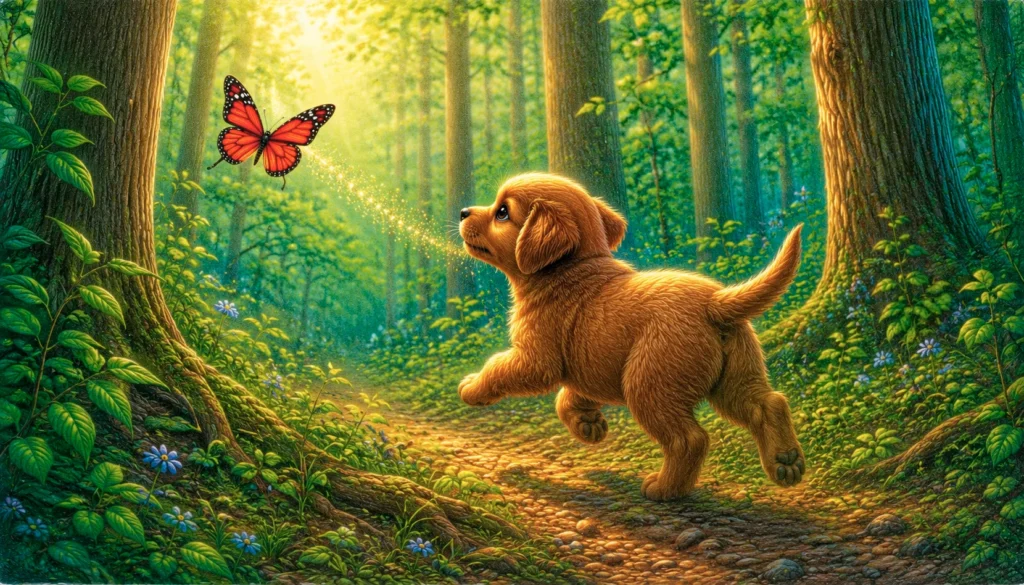
He had seen butterflies before. They were pleasant creatures, going about their butterfly business, not terribly interested in pups. This one was different. It was enormous — wings the color of a forest fire, black-edged and burning — and it was flying in a way that seemed less like flying and more like waiting for him to notice.
Pippan noticed.
The butterfly drifted left. Then right. Then directly toward the treeline, where the old forest began and the light changed quality entirely — cooler, greener, older somehow.
Pippan knew, in that instrument-without-a-name, that he was supposed to follow.
He also knew that following strange butterflies into old forests was not on any list of sensible things to do.
He followed anyway.
Chapter Three: Where the Clock Stopped
The path wasn’t really a path.
It was more like a series of suggestions — a gap between two roots here, a patch of soft moss there, the butterfly always just ahead, always just visible. The trees grew taller the further in he went, and the sounds of the meadow — the distant bark of a neighbor dog, the wind in the open grass — fell away behind him like a coat slipping off.
And then the butterfly was gone.
And Pippan was standing in a clearing he had never seen before, even though he had explored these woods a hundred times.
It was quiet in the clearing. Not the quiet of absence — not the quiet of a room where something has just ended. It was a full quiet. A quiet with weight to it. The kind of quiet that made Pippan feel, oddly, that he had been running for a very long time without knowing it, and had only just now stopped.
In the center of the clearing stood a tree.
Pippan had seen old trees before. He had seen trees that were wider than his whole family stretched end to end. But this tree was different in a way that had nothing to do with size. Its roots spread across the clearing floor like a map of every river that had ever existed. Its bark was carved by years into patterns that almost looked like writing in a language Pippan didn’t know. Its branches reached outward and upward in every direction, holding the sky the way cupped paws hold water.
The tree was not doing anything.
But Pippan had the distinct and slightly alarming feeling that the tree was aware of him.
He sat down. He wasn’t sure why. His legs just decided.
The hum was louder here. Or not louder exactly — closer. As if it had always been coming from just here and he had finally caught up to it.
Chapter Four: Solaris
“You look like you’re trying to hear something,” said a voice.
Pippan spun around so fast he nearly fell over.
On a red mushroom at the edge of the clearing sat a caterpillar. He was very green. He was eating a leaf with the focused, unhurried dedication of someone doing the most important work in the world.
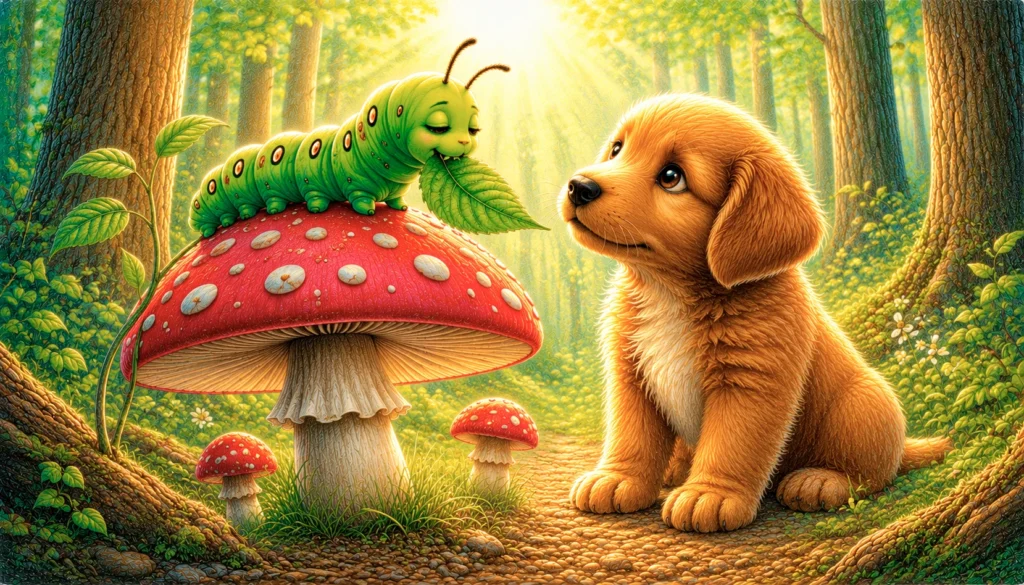
“I’m Solaris,” said the caterpillar, without looking up from his leaf.
“I’m Pippan,” said Pippan. “Are you the one who sent the butterfly?”
Solaris chewed thoughtfully. “No.”
“Do you know who did?”
“No.”
Pippan waited for more. No more came. Solaris turned his leaf with great care and began on the other side.
“Do you know what this place is?” Pippan tried.
Solaris glanced up at him then. His eyes were dark and round and remarkably calm — the eyes of a creature that had decided, long ago, not to be in a hurry about anything. “I know what it is to me,” he said. “I don’t know what it is to you. That seems like your job.”
Pippan opened his mouth. Closed it. Looked at the tree. Looked back at Solaris.
“That’s not very helpful,” he said.
“No,” agreed Solaris pleasantly, and went back to his leaf.
Chapter Five: The Pond That Remembered Everything
At the far edge of the clearing, half-hidden by roots, was a pond.
It was completely still. No ripples, no current — just a surface so smooth it looked like it had been poured and forgotten. The trees around it were reflected in it with such perfect clarity that Pippan had the dizzying feeling, standing at its edge, that he was looking not at a reflection but through a window into another clearing where everything was the same but somehow underneath.
He looked at his own face in the water.
His face looked back. But there was something strange. In the reflection, his eyes looked — not different exactly. More settled. Less like eyes that were always looking for the next thing and more like eyes that had arrived somewhere.
That’s not my face right now, Pippan thought. That’s my face if I stayed very still for a long time.
He didn’t know what to do with that thought, so he did the only reasonable thing.
He stepped in.

The water was cool but not cold. He waded out slowly, feeling the soft pond floor under his paws, and then he did something he had never done in water before: he stopped swimming. He let himself go still. He let the water hold him.
He floated on his back, looking up at the sky through the branches of the ancient tree. A cloud moved. A bird crossed without making a sound. Light came down in pieces between the leaves.
Nothing was happening.
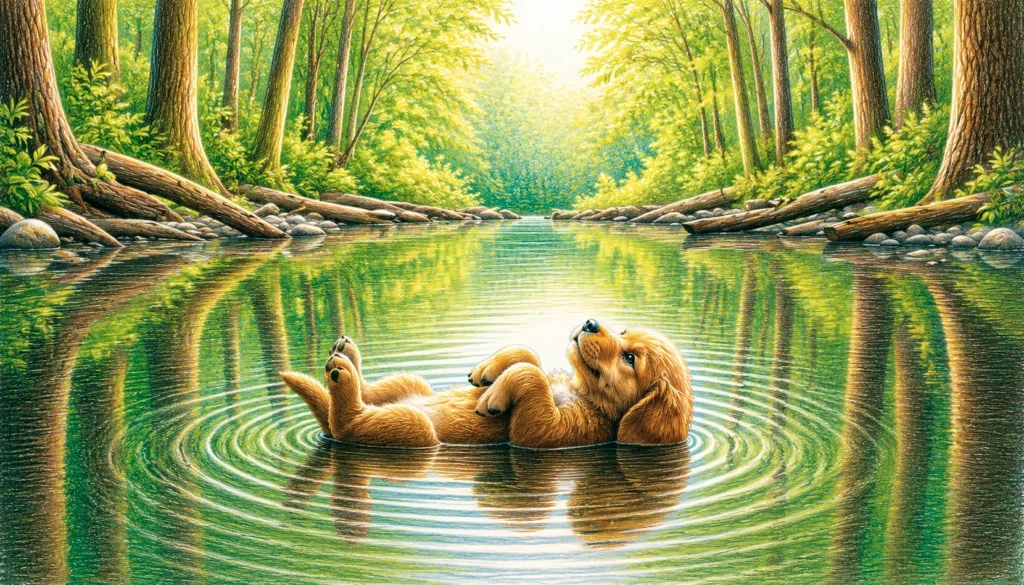
That was the strange part. Nothing was happening, and Pippan did not feel the need for anything to happen. The hum — the thing that had pulled at him for so long, the instrument without a name — was not silent. It was everywhere. It was the water holding him. It was the light coming through the leaves. It was the particular weight of the air in this clearing, pressed close and warm and ancient.
He was not happy exactly. He was something quieter than happy.
He was here. Completely here. Not thinking about the meadow behind him or the bowl waiting at home. Just: the water, the light, the tree, the sky.
He floated for a long time.
Chapter Six: What Solaris Said (And Didn’t Say)
When Pippan came back to the mushroom, dripping, Solaris had finished his leaf and was resting with his eyes half closed.
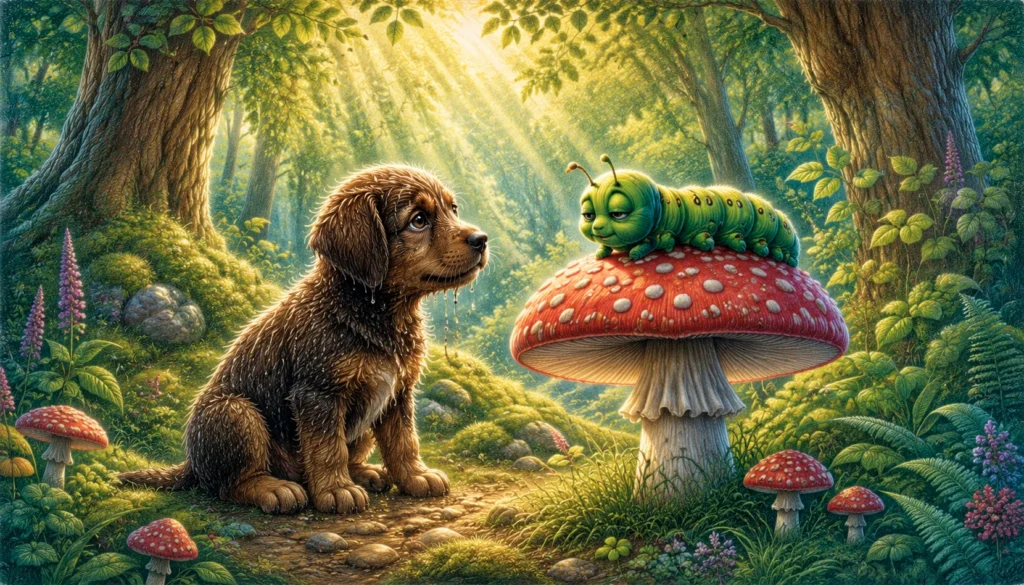
“I felt it,” Pippan said. “In the pond. I felt the hum.”
“Yes,” said Solaris.
“What is it?”
Solaris opened his eyes fully and looked at Pippan with that unhurried gaze. “You’re asking me to explain a feeling you just had with your whole body,” he said, “using words. That seems like the wrong tool.”
Pippan thought about this. “Okay,” he said. “Then — will I feel it again? Outside the clearing? When everything is loud and fast and I can’t stop?”
Solaris was quiet for a moment. A breeze moved through the clearing, turning the leaves so their pale undersides showed, and the whole clearing shimmered silver-green for just a second.
“I don’t know,” said Solaris finally. “I think that might be the part you have to find out yourself.”
It was, Pippan had to admit, still not very helpful. But this time it felt less like a closed door and more like a door that was — waiting.
Chapter Seven: The Long Way Home
The butterfly did not reappear to lead Pippan out.
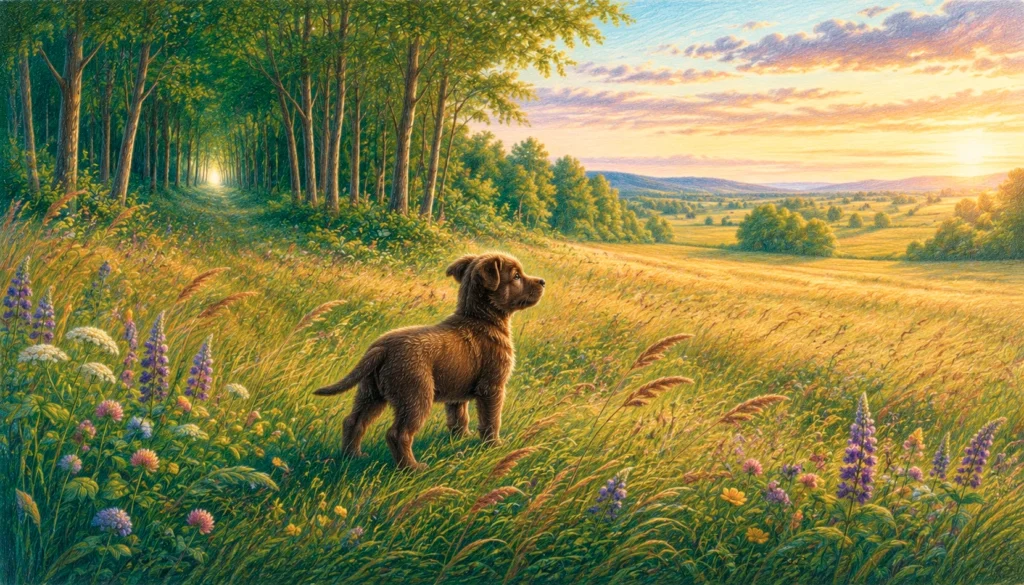
He found his own way — following the roots back to the path, the path back to where the trees thinned, the thinning trees back to the meadow and the familiar light and the distant sound of his brother still working on what was presumably a different stick by now.
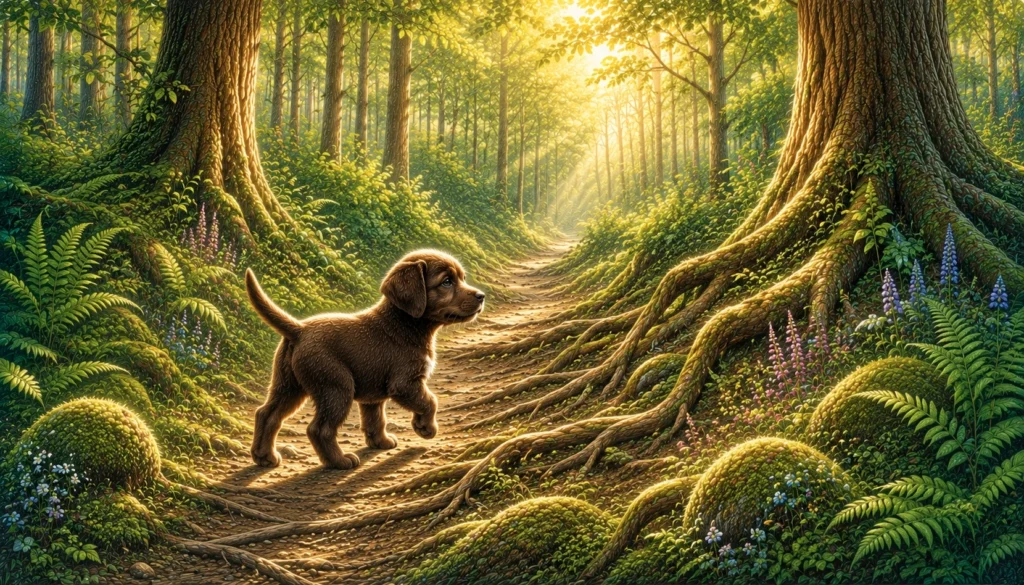
He paused at the treeline.
He looked back into the forest. He couldn’t see the clearing from here. He couldn’t hear the hum — not clearly. The meadow sounds were too loud. A dog barking two fields over. The wind in the grass. The ordinary percussion of the ordinary world.
But there was something. Very faint. Not quite sound, not quite feeling.
Like a song that had ended, but hadn’t entirely.
Pippan turned and walked back into the meadow.
Chapter Eight: That Evening
That evening, Pippan sat with his family as the sun went down.
His brother was telling a long story about the stick. His mother was half-listening, half-watching the sky turn colors. The evening star appeared, as it always did, in the same corner of the sky.
Pippan watched the star.

He thought about the pond. About floating. About the feeling of being held by something that didn’t need him to do anything, or be anywhere, or figure anything out.
He thought about Solaris: I think that might be the part you have to find out yourself.
He didn’t have an answer. He wasn’t sure the question had an answer — at least not one that could be said in words. But something had shifted, somewhere beneath his ribs, in the instrument without a name. It felt less like a question now and more like a door he knew the location of.
He could find it again. Maybe not today. Maybe not every day.
But it was there.
His mother nudged him gently. “Where are you tonight?” she asked.
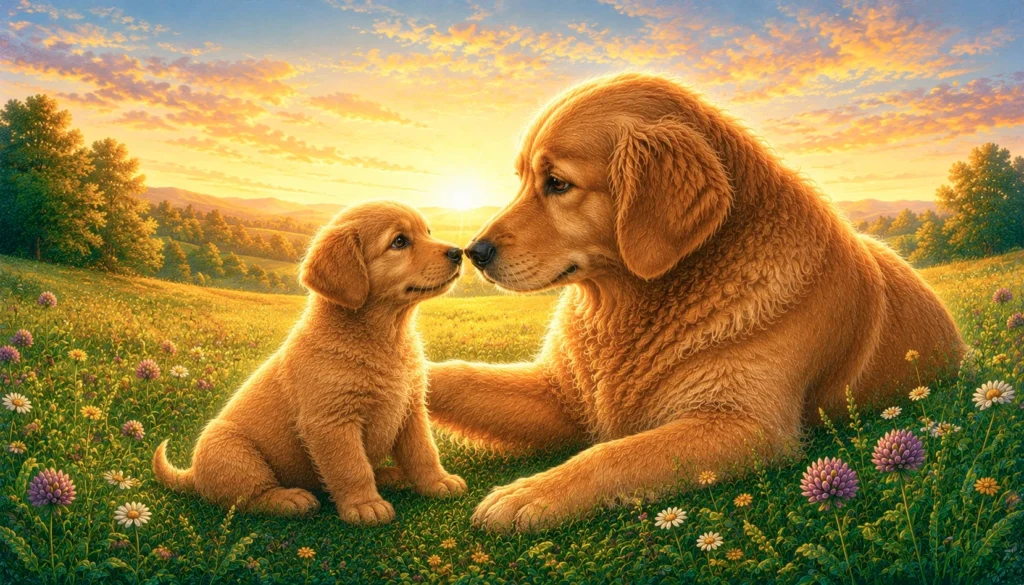
Pippan looked at the star. Then at her.
“Here,” he said.
She smiled and said nothing more.
The star held its place in the corner of the sky, steady and unhurried, as the sky deepened into evening.
The End