Arjun has an answer for everything, but he’s never truly listened to the world around him. This moving life lessons story follows his transformation in a school garden, where a wise mentor teaches him that the best way to learn is to quiet the mind and open the heart.
Chapter 1: The Know-It-All
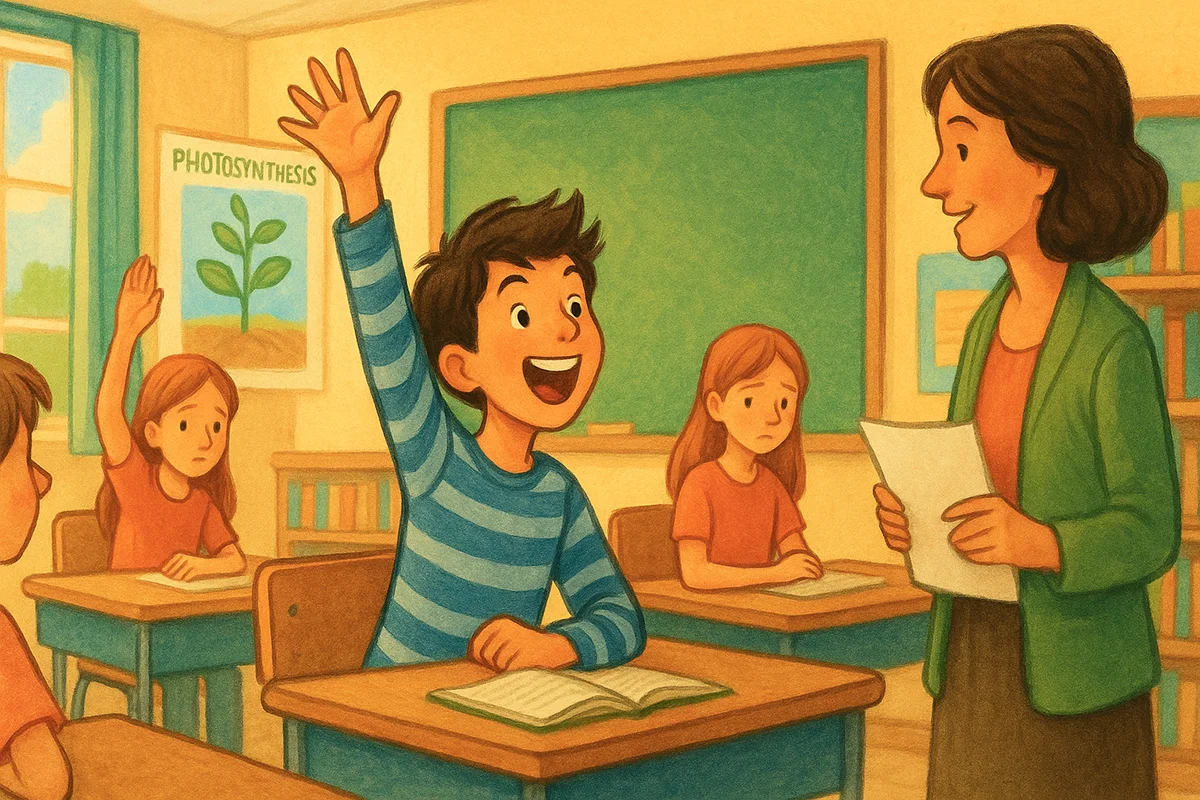
Arjun’s hand shot up before Ms. Kolar had even finished asking the question.
“I know! I know!” he called out, bouncing slightly in his seat. “The answer is photosynthesis! Plants use sunlight to make their own food through their leaves!”
Ms. Kolar smiled patiently. “That’s correct, Arjun, but I was asking about what Nea observed in her backyard garden yesterday.”
Nea, sitting two rows behind Arjun, had been raising her hand quietly. She lowered it with a small sigh.
“Oh,” said Arjun, not really listening. “Well, I bet I know what she saw anyway.”
This happened every day. In math class, Arjun would shout out formulas before problems were fully explained. In history, he’d interrupt stories to recite dates he’d memorized. During science experiments, he’d announce the results before anyone else had a chance to observe what was actually happening.
At recess, Arjun often found himself standing alone by the fence, watching his classmates play together in small groups. When he approached them, eager to share interesting facts he’d read the night before, they would listen politely for a moment before drifting away to continue their games.
“Did you know,” he once told Dale and Nea, “that ants can lift fifty times their own body weight?”
“That’s cool,” Dale had replied, but Nea was already pointing to something else. “Look at that butterfly! See how it only lands on the purple flowers?”
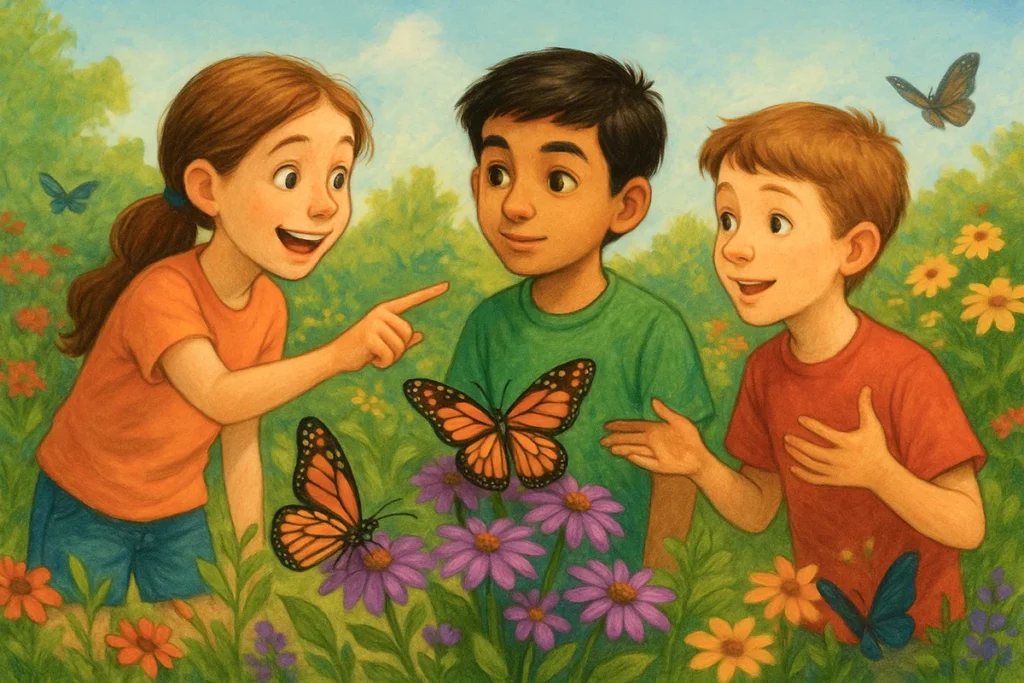
“Actually,” Arjun corrected, “butterflies are attracted to flowers based on their ultraviolet patterns, which humans can’t see. It’s not really about the color purple at all.”
Nea’s face fell. She stopped pointing and stepped back toward Dale.
“I was just… observing,” she said quietly.
Nea and Dale exchanged a glance and wandered off together, leaving Arjun wondering why nobody seemed interested in learning new things.
Ms. Kolar had been watching these interactions with growing concern. Arjun was bright and enthusiastic, but his need to always have the right answer was building walls between him and his classmates. She could see the loneliness in his eyes during group work, when children would choose partners and Arjun would be left hoping someone would pick him.
One September morning, she gathered the class on the reading carpet with an announcement.
“Children, I have wonderful news. Our school is starting a garden, and we have a very special person coming to help us tend it. His name is Master Capan, and he’s been growing plants for more than sixty years.”
“I know all about gardens! Arjun spoke out. “My mom has gardening books, and I’ve read about companion planting and soil pH and nitrogen cycles and—”
“That’s lovely, Arjun,” Ms. Kolar interrupted gently. “I think Master Capan will enjoy meeting someone so interested in gardens.”
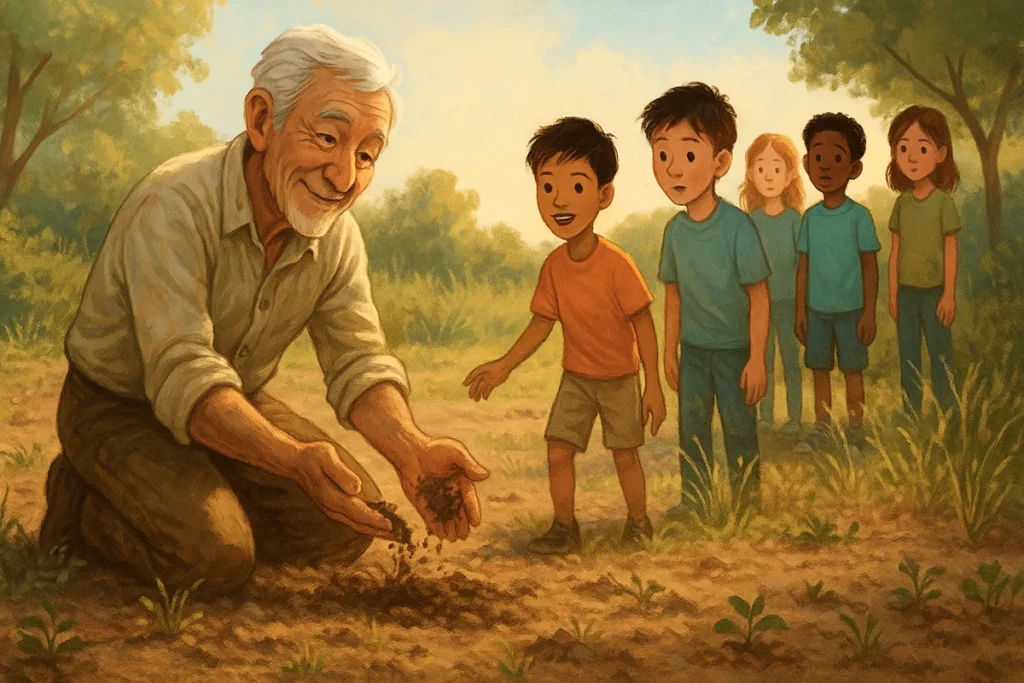
The next day, the children filed outside to the empty plot of land behind the school. Weeds grew in patches, and the soil looked hard and neglected. An elderly man was kneeling there, running the earth through his fingers. He was small and wiry, with silver hair and eyes that seemed to hold the warmth of sunlight on water.
“Good morning, young gardeners,” he said, rising slowly to his feet. “I am Master Capan. Who would like to help me understand what this land is telling us?”
Chapter 2: The First Question
Arjun’s hand waved for attention before anyone else could move.
“I can help! I know all about soil composition and drainage and which plants grow best in different conditions.” He stepped forward confidently. “You probably want to test the pH first, then add compost or fertilizer depending on what nutrients are missing. Then you should plan your rows based on how much sunlight each area gets throughout the day.”
The other children stood quietly, some looking impressed, others rolling their eyes in the way they’d learned to do when Arjun got started.
Master Capan listened to every word, nodding thoughtfully. When Arjun finished, the old man replied with gentle amusement.
“You know many words about growing gardens,” he said kindly. “But tell me, Arjun—Have you ever planted a seed and watched it grow?”
“Not exactly,” Arjun admitted, “but I’ve read all about it. Germination happens when moisture activates the enzymes in the seed coat, and then the radicle emerges first, followed by the—”
“Have you ever sat quietly with a plant and listened to what it needed?”
Arjun paused. “Well… plants don’t exactly talk. They’re not conscious like animals. They just respond to stimuli through biological processes.”
“Have you ever felt the joy of seeing something you’ve nurtured come into bloom?”
“I…” Arjun’s confident expression began to falter. “I mean, I’ve seen pictures of plants blooming. It’s just the reproductive phase of the plant’s life cycle.”
Master Capan stood up, brushing the soil from his hands. His voice remained warm, but there was something deeper in it now, like an invitation.
“So tell me again, young friend. What do you truly know about growing plants?”
The other children had never seen Arjun hesitate before. He always had an answer, always knew what to say. But now he stood there, his mouth opening and closing like a fish out of water.
“I…” he began, then stopped. The books he’d read seemed suddenly far away, full of words that felt hollow. “I… I don’t really know,” he whispered.
Master Capan’s face broke into the most beautiful smile, like sunrise after a long night.
“Good,” he said softly. “Now we can begin.”
Chapter 3: Learning to Listen
The next afternoon, Arjun hurried to the garden plot, eager to start learning what Master Capan would teach him. He had brought a notebook and three different pens, ready to take detailed notes on proper gardening techniques.
But Master Capan wasn’t holding any books or charts. He was simply kneeling in the dirt again, pulling weeds with his weathered hands.
“What should I write down?” Arjun asked, pen poised above his notebook.
“Nothing yet,” Master Capan replied, not looking up. “First, help me clear this section.”
Arjun knelt beside him, but kept glancing around expectantly. “When do we start the real lessons? About soil preparation and planting schedules?”
Master Capan continued pulling weeds, occasionally humming a tune that seemed to match the rhythm of his work. After a while, he sat back on his heels.
“Tell me, Arjun, what do you see here?”
Arjun looked around impatiently. “Weeds. Hard soil. Some rocks. When do we learn about the science part?”
“What do you hear?”
This was frustrating. “I hear… I don’t know, birds. Wind. Cars from the street. But what does that have to do with gardening?”
Master Capan picked up a small handful of seeds from his pocket. They were tiny and brown, unremarkable-looking. “These seeds know exactly how to become the plants they’re meant to be. Do you know how they know?”
“Well, it’s genetic programming. DNA contains the instructions for cellular development and—”
“Do you know how they know?” Master Capan asked again, more quietly.
Arjun stopped talking. Something in the old man’s tone made him actually think about the question instead of just answering it. How did a tiny seed know to send roots down and shoots up? How did it know when it was time to sprout, or how big to grow, or when to flower?
“I… no. I don’t know how they know.”
“Neither do I,” Master Capan said with a chuckle. “But they do know, don’t they? Perhaps if we watch quietly, they might show us.”
For the first time in his life, Arjun sat in the garden without talking. At first, it felt uncomfortable. His mind raced with facts and questions he wanted to share. But gradually, as Master Capan continued his quiet work, Arjun began to notice things he’d never seen before.
The way afternoon light fell differently on various parts of the plot. How some weeds grew in clusters while others stood alone. The busy trail of ants carrying tiny bits of debris. A small bird that kept returning to the same patch of turned earth, probably looking for insects.
When the gardening time was over, Arjun realized he’d forgotten about his notebook entirely.
“Same time tomorrow?” Master Capan asked.
Arjun nodded, though he wasn’t sure what they’d actually accomplished.
Day after day, he returned to the garden. Slowly, Master Capan began showing him how to prepare the soil, but not in the way Arjun had expected. Instead of lectures about nutrients and pH levels, the old man would have him feel different patches of earth between his fingers.
“What does this soil tell you?” he would ask.
At first, Arjun would try to remember what his books had said about soil texture and composition. But Master Capan would wait patiently until Arjun actually felt the dirt in his hands and described what he noticed—whether it was dry or moist, hard-packed or crumbly, full of roots or stones.
“Now you’re beginning to listen,” Master Capan would say with approval.
Chapter 4: The Power of Not-Knowing
Something strange began happening in the classroom. Arjun’s hand still went up during lessons, but now he was asking different kinds of questions.
During science class, he raised his hand and said, “Ms. Kolar, I was watching the plants in the garden, and I noticed the leaves turn to follow the sun during the day. How do they know which way to turn?”
His classmates began to notice the change. At recess, when Nea was again observing the butterflies, Arjun found himself genuinely curious instead of needing to correct her.
He said thoughtfully. “Have you noticed if it goes to other colors too?”
Nea’s face lit up. “Actually, yes! Yesterday I saw it on the yellow marigolds, but it stayed much longer on the purple ones. And it never went to the red flowers at all.”
“That’s really interesting,” Arjun said, and meant it. “I’ve never actually watched one choosing like you did.”
“You could watch with me tomorrow if you want,” Nea offered shyly.
For the first time, someone was inviting Arjun to join in rather than walking away from his explanations.
Dale overheard their conversation and came over. “My grandfather says butterflies are messengers from people who died. He can tell what kind of message it is by which flowers they visit.”
The old Arjun would have immediately corrected this as superstition, explaining the scientific reasons for butterfly behavior. But now, something made him pause.
“What kinds of messages?” he asked.
Dale’s eyes brightened. Nobody had ever asked him to share more about his grandfather’s stories. “Well, if they go to yellow flowers, it means someone is saying they’re proud of you. Purple flowers mean they want you to remember to be brave.”
“That’s beautiful,” Arjun said softly. “Your grandfather sounds very wise.”
Later that day in the garden, Arjun told Master Capan about the butterfly conversation.
“Nea really sees things,” he said, carefully transplanting a seedling. “And Dale’s grandfather has a whole different way of understanding butterflies. I used to think there was one right way to know about things.”
Master Capan nodded approvingly. “What do you think now?”
“I think… I think maybe knowing facts is just one way of understanding. Nea knows things by watching carefully. Dale’s grandfather knows things from years of living and paying attention to patterns. Arjun paused in his work. “I’m starting to think I don’t know very much at all.”
“And how does that feel?” Master Capan asked gently.
Arjun considered this. A few months ago, the idea of not knowing would have been very uncomfortable for him. Not knowing meant being wrong, being stupid, being left out. But now…
“It feels… exciting?” he said with surprise. “Like there’s so much more to discover. And like my friends might know things I’ve never even thought of.”
During lunch break, when Nea and Dale invited him to sit with them, Arjun didn’t bring up a single fact from any book. For the first time since starting school, Arjun felt like he truly belonged.
Chapter 5: The Second Question
Three months had passed since Master Capan’s arrival, and the school garden was beginning to take shape. Neat rows held tiny green seedlings, and the children had built a small compost bin in one corner. The once-hard soil was now dark and crumbly from the compost they’d mixed in.
One warm afternoon, as Arjun worked quietly beside Master Capan, watering the young tomato plants, Master Capan straightened up and looked at Arjun.
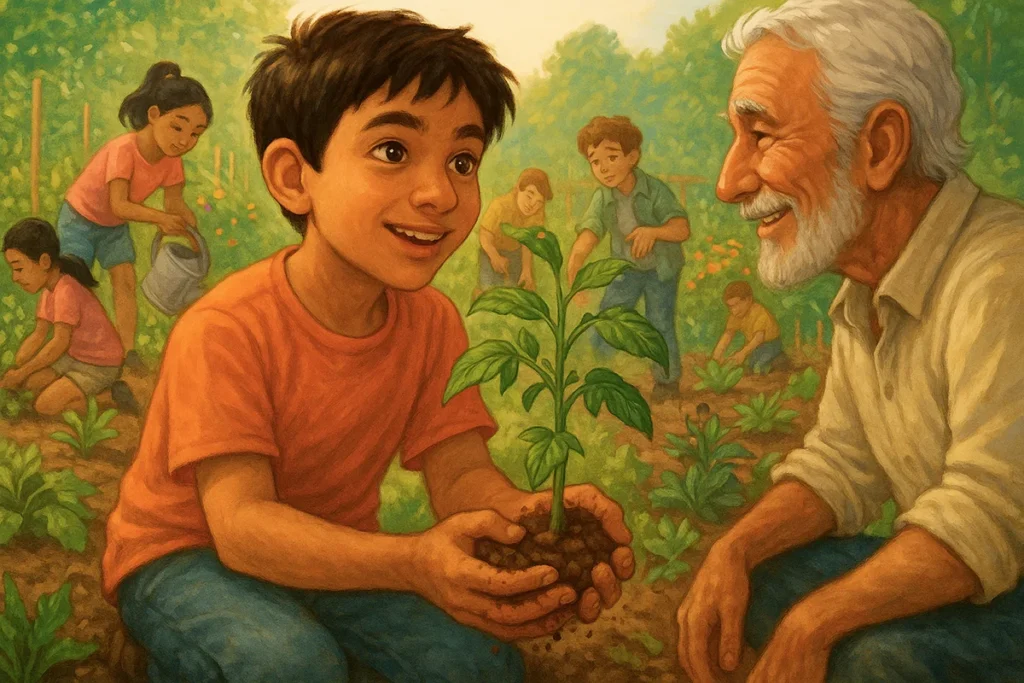
“Tell me, my young friend,” he said with the same gentle tone he’d used months earlier, “what do you know about growing the garden?”
Arjun’s first instinct was to share everything he’d learned. He opened his mouth to begin listing all his new knowledge.
Then he stopped.
He looked around the garden, remembering all the quiet moments he’d spent there. The day he’d sat perfectly still and watched a beetle navigate through the lettuce leaves. The morning he’d arrived to find their first tomato flower blooming. The afternoon Nea had shown him how to tell when the soil was the right moisture for planting seeds.
“I know how to watch, and listen, and learn from everything around me.”
He paused, looking at the plants they’d tended together. “I know that every plant is different, even the ones that are supposed to be the same variety. I know that some days the garden needs water and some days it doesn’t, and you can tell by touching the soil and looking at the leaves.”
Master Capan nodded encouragingly.
“I know that Nea notices things about insects that I never would have seen. I know that Dale’s way of talking to the plants while he weeds them seems to help them grow better. I know that Mrs. Peterson from the neighboring classroom has taught me more about pruning in ten minutes than I learned from reading about it for an hour.”
Arjun’s voice grew more excited as he spoke. “I know that every person who helps in this garden knows something different and important. And I know that the more I watch and listen, the more interesting everything becomes.”
Master Capan’s smile was warm with approval. “You are learning to see with wisdom’s eyes,” he said softly.
Chapter 6: The Third Question
As spring turned to summer, the garden flourished. Tomatoes hung heavy on their vines, beans climbed the trellises the children had built, and flowers attracted clouds of butterflies and bees. The whole school had become involved in the project, with different classes taking turns to water, weed, and harvest.
Arjun had become something of a bridge between Master Capan and the other children. When new students joined the gardening group, he would show them around, sharing what he had learned and what he was still wondering about.
“See these cucumber plants?” he might say to a newcomer. “I’m trying to figure out why some of them are growing so much faster than others, even though they’re all getting the same care. What do you notice about them?”
The young visitor would look more closely, sometimes noticing things Arjun had missed—that the faster-growing plants were in a spot that got more morning sun, or that they were planted slightly deeper in the soil.
“That’s a great observation!” Arjun would say with genuine enthusiasm. “I wonder what Master Capan would think about that.”
On the last day of school, as children were harvesting vegetables to take home and saying goodbye to the garden for the summer, Master Capan asked his question one final time.
The whole class was gathered in the garden, sitting in a circle on the grass. The late afternoon sun cast everything in golden light, and the air hummed with the contentment of bees and the rustle of leaves.
“Arjun,” Master Capan said with ceremonial solemnity, “what do you know about growing gardens?”
Arjun looked around the circle at his classmates—Nea with dirt under her fingernails from digging carrots, Dale gently stroking the leaves of the bean plants, all the other children who had become his partners in discovery. He looked at the garden they had created together, abundant and alive.
Taking a deep breath, he spoke from the deepest part of his understanding.
“I know that everything is connected,” he said quietly. “When I help the garden grow, it helps me grow too. When I learn from my friends, we all become wiser together. When I take care of the plants, they take care of me by giving me food and beauty and peace.”
He paused, searching for words big enough to hold what he’d discovered.
“I know that I am part of something much bigger and more wonderful than just me. The soil, the seeds, the rain, the sun, my friends, Master Capan, even the earthworms and beetles—we’re all working together to create life. And when I remember that, when I really feel it, it’s like…” He struggled to find the right way to express it.
“It’s like I become not just Arjun who knows some facts about plants, but part of the wisdom that helps everything grow.”
Master Capan’s eyes filled with joy, and when he spoke, his voice carried the warmth of deep recognition.
“Now you speak with the voice of wisdom itself, my young friend.”
Chapter 7: The Circle Complete
The following September, Arjun returned to school as a fifth-grader. The garden had been maintained over the summer by volunteer families, and it welcomed the children back with late tomatoes, autumn flowers, and the promise of a new growing season.
Ms. Kolar had moved up to teach fifth grade, and she watched with quiet satisfaction as Arjun introduced the new third-graders to the garden. His approach was nothing like his old know-it-all self, but it wasn’t the opposite either. He had found a balance between sharing knowledge and nurturing curiosity.
“This is where we grow vegetables for the school cafeteria,” he explained to a group of wide-eyed eight-year-olds. “And these flowers help attract bees and butterflies that pollinate our food plants. But the really cool thing is how much the garden can teach us if we pay attention.”
A small girl named Sam raised her hand. “What should I know about gardening?”
Arjun smiled the same kind of smile Master Capan had given him a year ago.
“That’s a great question, Sam. Let’s discover what the garden wants to teach us.”
Arjun knelt to tend the fall plantings, his hands working in the rich soil that a year of many hands had created. Around him, the garden hummed with quiet life, and in his heart, he carried the understanding that had transformed him from a boy who claimed to know everything into a young person who had discovered the joy and wisdom of deep listening.
The End