
When the whole school starts whispering about free ice cream forever, Daxa knows it’s time to investigate. These 5 min stories teach children how to think for themselves, ask the right questions, and avoid “following the crowd.” It’s the perfect bedtime tale for raising little leaders with big questions.
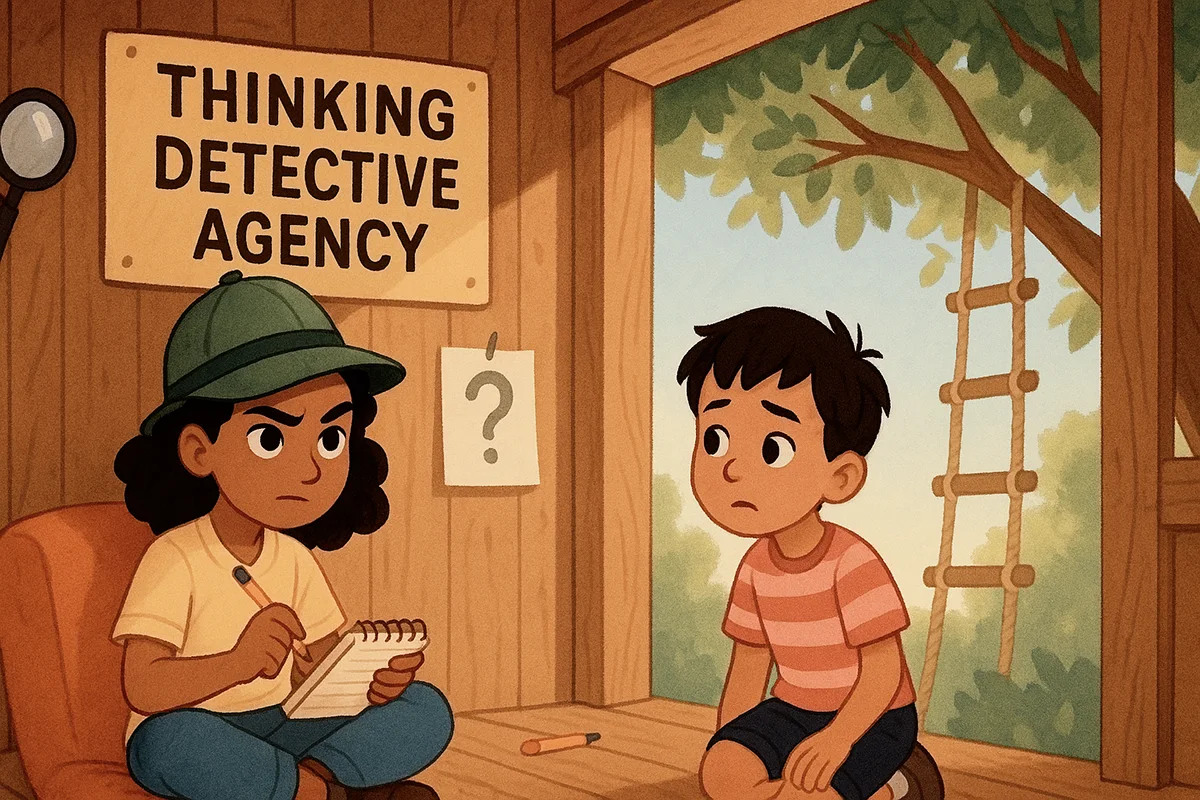
Daxa was the kind of kid who asked “Why?” about everything. Her little brother Lal thought she was weird, but Daxa didn’t mind. She had just started her own detective agency in their treehouse, and today she had her first real case.
“Daxa! Daxa!” Lal came running up the rope ladder, out of breath. “Everyone at school is saying the new ice cream truck is giving away free ice cream forever!”
“Really?” Daxa raised an eyebrow. “That sounds too good to be true. Tell me exactly what happened.”
Lal plopped down on the old beanbag. “Well, Jenny heard from Marcus, who heard from his sister, who heard from someone in high school that the ice cream man won the lottery and now he’s giving away ice cream for free!”
“Hmm,” Daxa said, pulling out her detective notebook. “So you didn’t actually see this happen yourself?”
“No, but everyone’s talking about it! Come on, let’s go get our free ice cream before it’s all gone!”
Daxa tapped her pencil against her chin. “Wait, Lal. Let’s think about this like detectives. What if this story isn’t true?”
“But why would everyone be talking about it if it wasn’t true?” Lal asked.
“Remember last month when everyone thought our teacher was getting married because someone saw her talking to a man in the parking lot?”
Lal’s face fell. “Oh yeah… and it turned out to be her brother picking her up because her car broke down.”
“Exactly! Sometimes stories spread really fast, even when they’re not true. It’s like a game of telephone – the message changes as it passes from person to person.”
“So what should we do?” Lal asked.
Daxa stood up and grabbed her detective hat. “We investigate! Let’s go talk to the ice cream man himself.”

They climbed down from the treehouse and walked to the park where the ice cream truck usually stopped. Sure enough, there was a long line of kids, all chattering excitedly about free ice cream.
“Look at all these kids!” Lal whispered. “They can’t all be wrong, can they?”
“That’s what detectives call ‘following the crowd,'” Daxa explained. “Just because lots of people believe something doesn’t make it true. Remember when everyone used to think the Earth was flat?”
They approached the ice cream truck. Mr. Bing, the ice cream man, looked confused and a little overwhelmed by the crowd.
“Excuse me, Mr. Bing,” Daxa said politely. “All these kids are here because they heard you’re giving away free ice cream. Is that true?”

Mr. Bing chuckled and shook his head. “Oh my! No, no, that’s not true at all. I’m not sure how that rumor started, but I’m definitely not giving away free ice cream. I wish I could, but I have a family to feed!”
The kids in line started grumbling and walking away, disappointed.
“See?” Daxa said to Lal. “That’s why we always need to check our facts before we believe something, even if everyone else believes it.”
“But Daxa,” Lal said, looking confused, “how do we know when to believe something and when to question it?”
Daxa sat down on a nearby bench and patted the spot next to her. “Great question! Here’s what I’ve learned from all my detective work: Our brains like to take shortcuts to make decisions quickly. That’s not always bad – it helps us react fast when we’re in danger. But sometimes these shortcuts trick us.”
“What do you mean?” Lal asked.
“Well, like today. Your brain heard ‘free ice cream’ and thought ‘that sounds amazing!’ without stopping to ask questions like ‘Does this make sense?’ or ‘Who actually saw this happen?'”
Lal nodded slowly. “So our brains can be kind of lazy sometimes?”
“Not lazy exactly, but they like to find the easiest path. It’s like when you’re walking and you see two paths – one that’s straight and easy, and one that’s winding and harder. Your brain usually picks the easy one, even if the harder one might lead to something better.”
“So how do I become a better thinker like you, Daxa?”
Daxa grinned. “Want to learn my secret detective tricks?”
“Yes!”
“First trick: Always ask ‘How do I know this is true?’ When someone tells you something, ask yourself – did I see it happen? Did someone I trust actually witness it? Or is it just a story that’s been passed around?”
“Okay, that makes sense.”
“Second trick: Play devil’s advocate with yourself.”
“What’s that?”
“It means arguing with your own ideas. Like, if your first thought is ‘This must be true,’ then you ask yourself ‘But what if it’s not true? What evidence do I have against it?'”
Lal scrunched up his face. “That sounds hard.”
“It is hard! That’s why most people don’t do it. But that’s what makes great detectives special – we do the hard thinking work.”
Just then, their friend Boba ran up to them, panting. “Daxa! Lal! Did you hear? The principal is canceling homework forever because some famous person complained about it on TV!”
Lal’s eyes lit up, but then he glanced at Daxa and paused. “Wait… Boba, did you actually hear the principal say this?”
Boba looked confused. “Well, no, but Tommy heard it from his cousin who goes to the middle school…”
Daxa smiled proudly at Lal. “Boba, before we get too excited, maybe we should check with the principal’s office?”
“But why would Tommy make it up?” Boba asked.
“He probably didn’t make it up on purpose,” Daxa explained. “But sometimes people hear part of a story and fill in the missing pieces with what they want to be true. It’s like our brains are trying to solve a puzzle, but they use the wrong pieces.”
Boba frowned. “So you think it’s not true?”
“I think we should find out for sure,” Daxa said. “Want to come with us to the principal’s office?”
“I guess…” Boba said, though she looked disappointed.
As they walked toward the school, Lal asked, “Daxa, why do people’s brains do this? Why don’t they just think clearly all the time?”
“Well,” Daxa said, “imagine if you had to carefully think through every single decision you make all day long. Like, really think hard about how to tie your shoes, or whether to brush your teeth, or which foot to put forward when you walk. You’d be exhausted!”
“That would take forever!” Boba laughed.
“Exactly! So our brains developed shortcuts to help us make quick decisions about everyday stuff. The problem is, these shortcuts don’t work well for complicated or important things.”
“Like free ice cream rumors?” Lal asked.
“Like free ice cream rumors,” Daxa confirmed.

When they reached the principal’s office, Mrs. Patterson was happy to answer their question.
“Oh my goodness, no!” she laughed. “Homework hasn’t been canceled. In fact, I was just reviewing the new homework policy we’re implementing next month to make sure students are getting the right amount of practice at home.”
Boba’s shoulders sagged. “I should have known it was too good to be true.”
“Hey,” Daxa said, putting her hand on Boba’s shoulder, “now you know how to be a thinking detective too! Next time you hear something that sounds too amazing, you’ll know to investigate first.”
“But Daxa,” Lal said as they walked home, “doesn’t this mean we have to doubt everything? That sounds kind of sad.”
Daxa thought for a moment. “Not everything, Lal. We can still enjoy stories and use our imagination. And we can still trust people we know well. But for important stuff – especially stuff that affects our decisions – it’s good to be a thinking detective.”
“What kind of important stuff?”
“Like if someone tries to convince you that all kids from a certain school are mean, or that you can’t be good at math because you’re not naturally smart, or that you should do something that doesn’t feel right because ‘everyone else is doing it.'”
“Oh,” Lal said quietly. “Like when those older kids said I was weird for reading during recess instead of playing soccer.”
“Exactly! Just because they said it doesn’t make it true. What do YOU think about reading during recess?”
Lal smiled. “I think it’s awesome. I love stories, and recess is the perfect time to read without anyone interrupting me.”
“There you go! That’s your own thinking, not just following what someone else says.”
Boba had been quiet for a while, but now she spoke up. “Daxa, this is really hard. How do you remember to think like a detective all the time?”
“I don’t do it all the time,” Daxa admitted. “Sometimes I catch myself believing things without checking them too. But I’ve been practicing, and it gets easier. Want to know a trick?”
“Yeah!”
“I ask myself three questions: First, ‘Does this seem too good to be true or too scary to be real?’ Second, ‘Who actually saw this happen?’ And third, ‘What would happen if I’m wrong about this?'”
Lal counted on his fingers. “So for the ice cream thing… it seemed too good to be true, nobody actually saw it happen, and if we were wrong, we’d waste our time standing in line for nothing.”
“Perfect!” Daxa said. “You’re already getting good at this.”
As they reached Daxa’s house, Boba asked, “Daxa, why do you like thinking so much? Isn’t it easier to just go with what everyone else thinks?”
Daxa sat down on her front steps and looked up at the sky. “You know what, Boba? It is easier. But I’ve noticed something cool about thinking for myself.”
“What?”
“I make better decisions. I don’t get disappointed as much because I don’t believe things that are too good to be true. And I’ve discovered some really amazing things that other people missed because they weren’t paying attention.”
“Like what?” Lal asked.
“Like last week, everyone was complaining about how boring the new substitute teacher was. But I actually listened to her stories, and it turns out she used to be an astronaut! While everyone else was grumbling, I got to hear incredible stories about space.”
“Wow!” Boba said. “So thinking for yourself can help you discover cool things?”
“Exactly. And it helps me be a better friend too. Instead of just agreeing with gossip about someone, I can make up my own mind about people.”
Lal stood up and brushed off his pants. “Daxa, I want to be a thinking detective too. Will you teach me more tricks?”
“Of course! But remember, the most important thing is to be curious. Keep asking questions, keep wondering ‘what if,’ and don’t be afraid to think differently from everyone else.”
“Even if people think we’re weird?” Boba asked.
Daxa grinned. “Especially then. Some of the best discoveries in the world were made by people who thought differently. Besides, I’d rather be weird and right than normal and wrong.”

As the sun started to set, the three friends made a pact to help each other become better thinkers. They would question rumors, check their facts, and most importantly, never stop asking “Why?”
“Tomorrow,” Daxa announced, “we’re going to investigate the rumor that the cafeteria is putting vegetables in the chocolate milk.”
“Eww!” Lal and Boba said together.
“But first,” Daxa said with a wink, “we’re going to ask ourselves: does this seem likely? Who told us this? And what evidence do we actually have?”
And with that, the Thinking Detective Agency was officially open for business, ready to solve the mysteries of everyday life, one question at a time.