

Marcus knows everything about leadership — just ask him. The problem? His shirt’s inside out, his shoes don’t match, and his team keeps losing. One of our funniest kids stories follows a well-meaning know-it-all through the most hilariously humbling field day of his life, straight to a lesson he never saw coming.
The Leadership Expert
Marcus Kellerman had leadership figured out. The problem was, nobody else at Millfield Middle School seemed to understand what real leadership looked like.
Take kickball, for instance. Every day at recess, Marcus watched his classmates make the same basic mistakes. “Come on, Sarah!” he’d call from the sidelines after striking out himself. “You’ve got to follow through on that kick!” Never mind that his own attempt had resulted in a spectacular whiff that left him spinning.
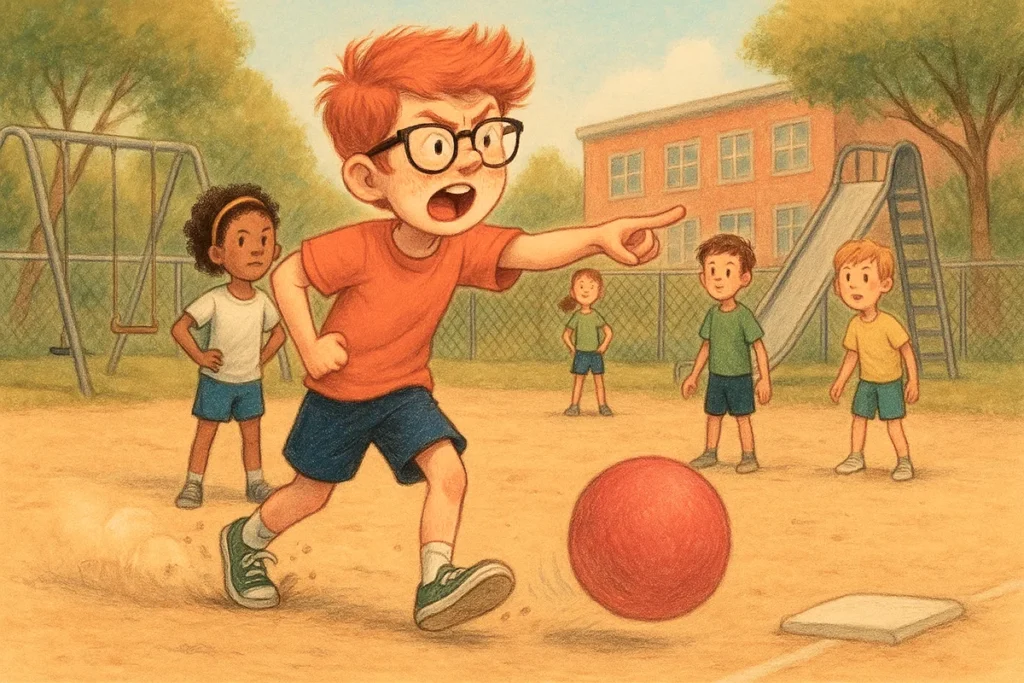
“Watch your base running, Josh!” Marcus would shout, jogging back from first base where he’d been tagged out for the third time that week. “You can’t just run in a straight line like that!”
His teammates had learned to tune him out, but Marcus figured that was just because they weren’t ready to hear the truth yet. Real leaders, he guessed, had to be patient with people.
In the cafeteria, Marcus observed the chaos with a critical eye. “This lunch line is completely disorganized,” he announced to anyone within earshot, while frantically patting down his pockets. “Where’s my lunch money? I swear I had it this morning.” He ended up borrowing two dollars from his friend Pete, same as he had yesterday and the day before.
“The monitors should have a system,” Marcus continued, cutting in front of three fourth-graders who were too polite to protest. “You need proper traffic flow, clear directions, maybe some signs.” He grabbed a tray and promptly knocked over a stack of napkins with his elbow.

But it was during group projects that Marcus’s leadership skills really shone. When Mrs. Patterson announced they’d be working in teams of four to create presentations about the solar system, Marcus immediately took charge of his group.
“Okay, team,” he said, pulling out a notebook that was somehow already three weeks behind on math homework. “Here’s what we’re going to do. Amy, you’re on visual aids. Pete, you handle the research on the outer planets. Jake, you’ve got the inner planets. And I’ll coordinate everything and do the presentation.”
“What about your own research?” Amy asked.
Marcus waved his hand dismissively. “Don’t worry about me. I’ve got this covered. The key to a good presentation is strong leadership and clear delegation.” He flipped through his empty notebook confidently. “I’ll get started on my part tonight.”

That night, Marcus got distracted by a three-hour documentary about space exploration and forgot entirely about the actual assignment.
The next morning, Mrs. Patterson made an announcement that sent a thrill through Marcus’s entire body.
“Class, as you know, our annual sixth-grade field day is coming up next Friday. Each homeroom needs to select a team captain who will lead their class in the various events.”
Marcus sat up straighter. This was it. This was his moment.
“I’d like everyone to think carefully about who would be the best leader for our class,” Mrs. Patterson continued. “We’ll vote tomorrow.”
Marcus spent the rest of the day mentally preparing his campaign speech. He had so much to offer. He understood strategy, he recognized talent, he could see the big picture in a way that his classmates simply couldn’t.
That afternoon, he cornered Pete by the bike racks. “So, Pete, I assume I can count on your vote tomorrow?”
Pete shifted uncomfortably. “Well, I don’t know, Marcus. I mean, Tommy Chen is pretty good at sports, and he’s really organized…”
“Tommy Chen?” Marcus nearly dropped his backpack. “Pete, think about this strategically. Sure, Tommy can kick a ball, but can he see the forest for the trees? Can he coordinate multiple moving parts? Can he inspire a team to greatness?”
Pete looked skeptical. “Can you?”
“Are you kidding?” Marcus gestured toward the kickball field where a group of kids were playing. “I’ve been coaching you guys all year! Remember when I told Sarah about her follow-through? Or when I explained proper base-running technique to Josh?”
“I remember you striking out right before you gave Sarah that advice,” Pete said. “And didn’t Josh tag you out like five seconds after you explained base-running to him?”
Marcus brushed this off. “Pete, leadership isn’t about being perfect. It’s about vision. It’s about seeing what others can’t see.”
The next day, Marcus delivered what he considered a stirring campaign speech. He talked about teamwork, about strategy, about the importance of strong leadership in achieving victory. He outlined his qualifications, his dedication to the class, his understanding of what it took to win.
When the votes were counted, Tommy Chen won by a landslide.
Marcus was genuinely baffled. “I don’t understand it,” he told his mom that evening. “I mean, Tommy’s a nice guy, but he doesn’t have the leadership experience that I do.”
“What leadership experience is that, honey?” his mom asked, trying to keep a straight face.
“Well, I’ve been providing guidance to the kickball team all year. I’ve been helping coordinate our group projects. I’ve been observing what works and what doesn’t work in various team situations.”
His mom nodded thoughtfully. “And how have those things been going?”
“They’d be going a lot better if people would listen to my advice,” Marcus said confidently.
The Big Break
Thursday afternoon, disaster struck. Tommy Chen came down with the flu.
Mrs. Patterson pulled Marcus aside after lunch. “Marcus, since you were runner-up in the voting, would you be willing to step in as team captain for tomorrow’s field day?”
Marcus tried to contain his excitement. “Well, Mrs. Patterson, I suppose I could make that sacrifice for the good of the team.”
“Wonderful. Now, you’ll need to bring back this permission slip signed by your parents, and make sure you’re here by 8 AM sharp tomorrow. The captain needs to check in all the team members and go over the event schedule with the other captains.”
Marcus grabbed the permission slip. Finally, his classmates would see what real leadership looked like.

That evening, Marcus spread out papers across his bedroom floor, creating what he called his “field day strategy map.” He drew diagrams for optimal relay positioning, calculated the best batting order for kickball, and even choreographed a team cheer.
His little sister Emma peeked into his room. “What’s all this?”
“This, Emma, is how you win field day. See, most captains just wing it, but I’m approaching this scientifically. Strategic positioning, psychological preparation, tactical advantages…”
“Is that why your socks don’t match?” Emma asked, pointing at his feet.
Marcus looked down. He was wearing one blue sock and one red sock. “That’s… that’s not important right now, Emma. We’re talking about leadership.”
“Okay, but why is your shirt inside out?”
Marcus glanced at himself in the mirror. His t-shirt was indeed inside out, the seams clearly visible. “Look, Emma, details like that are exactly what separate real leaders from people who get distracted by minor issues.”
Emma shrugged and left him to his planning.
Captain Marcus Reporting for Duty
Marcus stayed up until nearly midnight, perfecting his strategies, then fell asleep on top of his papers. In the morning, he woke up in a panic, realizing he’d forgotten to get his parents to sign the permission slip. He raced downstairs, got his mom’s signature, grabbed what he thought was his field day outfit, and sprinted to school.
He arrived at 8:15, slightly out of breath and very eager to assert his leadership.
“Marcus!” Mrs. Patterson called. “There you are. The other captains are already meeting in the gym.”
Marcus hurried to the gym, where five other sixth-grade captains were standing in a circle with Coach Williams. They all looked very official and prepared. Marcus tried to project the same aura of competence.
“All right, captains,” Coach Williams said, “let’s go over the event schedule. First up is the three-legged race, then relay races, then tug-of-war, and we’ll finish with kickball. Any questions?”
Marcus raised his hand. “Coach Williams, I’ve prepared some strategic recommendations for optimal team performance that I think would benefit all the classes.”
The other captains exchanged glances. Tommy’s replacement captain from Mrs. Rodriguez’s class, a girl named Maya, spoke up. “I think we should probably just focus on having fun and doing our best.”
“Well, yes,” Marcus said, “but fun and doing your best are much more achievable with proper strategic planning. For instance, in the relay race, most teams don’t consider the psychological impact of running order, or the aerodynamic advantages of…”
“Marcus,” Coach Williams interrupted gently, “why don’t you save the strategy talk for your own team? You should probably go get them organized.”
Marcus nodded and jogged back toward his classroom, feeling confident about the impression he’d made on the other captains. His classmates were gathered on the playground, looking around uncertainly.

“All right, team!” Marcus called out, jogging up to them. “Captain Marcus reporting for duty!”
A few kids giggled. Pete pointed at Marcus’s feet. “Dude, your shoes don’t match.”
Marcus looked down. He was wearing one sneaker and one dress shoe. In his morning rush, he’d grabbed the first two shoes he’d found, apparently from different pairs.
“That’s… that’s actually a tactical choice,” Marcus said quickly. “Different sole patterns provide different advantages depending on the terrain.”
“What about your shorts?” Amy asked.
Marcus twisted around to look at himself. His gym shorts were on backwards.
“Again, tactical,” Marcus said, though he was starting to feel less confident. “Better weight distribution.”
The first event was the three-legged race. Marcus had elaborate plans for this one.
“Okay, Sarah, you’re partnered with Jake. Pete, you’re with Amy. The key here is synchronized breathing and matching stride length. You need to find a rhythm that…”
“Marcus,” Sarah interrupted, “who are you partnered with?”
Marcus looked around. There was an odd number of kids in their class. “I guess… I guess I’m not racing this one.”
“But you’re the captain,” Jake pointed out. “Shouldn’t you be competing?”
“Right, yes, of course.” Marcus looked around frantically. “I’ll partner with… um…” He spotted Mrs. Patterson nearby. “Mrs. Patterson! Want to be my three-legged race partner?”
Mrs. Patterson laughed. “I think I’ll sit this one out, Marcus. Maybe you could be the official cheerleader for this event?”
So Marcus found himself on the sidelines, shouting encouragement and strategic advice to his teammates. “Remember your breathing, Sarah! Jake, match her stride! No, shorter steps! Actually, longer steps! Find the rhythm!”
His team came in fourth out of six classes.
The relay race was next, and Marcus was determined to compete in this one. He’d studied the optimal baton-passing techniques and had strong opinions about running order.
“I’ll run anchor,” he announced, “because the anchor leg is the most crucial and requires the most experience.”
“Don’t you mean you want to run first?” Pete asked. “You know, to get us off to a good start?”
Marcus paused. He’d been so focused on the importance of the anchor position that he’d forgotten the anchor actually ran last. “Right, yes, that’s what I meant. I’ll run first leg, because leadership means leading from the front.”
The race began, and Marcus took off with the baton, determined to give his team a strong start. He was so focused on his form and his breathing and his strategic pacing that he forgot to look where he was going. He veered slightly off course, then overcorrected, then stumbled slightly but kept running.
When he reached Pete, he was so excited about his performance that he forgot which hand he was supposed to pass the baton with. He thrust it forward with his left hand just as Pete reached back with his right hand. They fumbled the pass, the baton hit the ground, and Pete had to stop and pick it up.
“Sorry!” Marcus called, as Pete took off. “That was a strategic misdirection!”
His team came in fifth.
Strategic Pulling
By the time they reached tug-of-war, Marcus’s confidence was wavering slightly, but he rallied. This was an event that was all about strategy and positioning.
“All right, team,” he said, as they gathered around the thick rope. “Tug-of-war is ninety percent technique and ten percent strength. It’s all about foot placement, grip spacing, and coordinated pulling rhythm.”
He positioned himself at the back of the line, explaining that the end position was crucial for leverage and strategy. “I’ll call out the rhythm,” he said. “When I say ‘pull,’ everyone pulls together. When I say ‘hold,’ we dig in our heels and maintain position.”
The whistle blew, and Marcus immediately began shouting instructions. “Pull! Hold! Adjust your grip! Sarah, widen your stance! Pete, lean back more! Pull! No, not yet! Wait for my signal! Pull!”
His teammates, confused by the constant stream of contradictory commands, pulled at different times and in different directions. Meanwhile, Marcus was so focused on giving directions that he forgot to pay attention to his own footing.
“Watch your balance, everyone!” he called out, just as he lost his own balance entirely.
Marcus toppled backward, his feet slipping out from under him. His fall created a chain reaction that sent half his team tumbling down in a heap.

They lay there in a tangle of arms and legs and rope, while the other team stood victorious on the other side.
For a moment, there was silence. Then Jake, who was somehow twisted upside down with his legs in the air, started laughing.
“You know what, Marcus?” Jake said, still giggling. “Maybe next time we should just pull really hard and see what happens.”
Amy, who was lying on her back with her feet tangled in the rope, started laughing too. “Yeah, like, really, really hard.”
“All at the same time,” Pete added, grinning.
“Without anyone telling us when,” Sarah said.
Marcus could hear his teammates laughing around him.
And suddenly, he started laughing too.
“You know what?” he said. “You guys might be onto something.”
A Different Kind of Captain
For the kickball game, Marcus took a different approach. Instead of positioning himself as the star player, he asked his teammates what positions they wanted to play. Instead of giving detailed instructions about kicking technique, he just said, “Try to have fun.”
And something amazing happened. Without Marcus’s constant coaching, his teammates relaxed. They played better than they had all year. They came in second place in kickball, their best showing of the day.
After the event, as they were walking back to the classroom, Pete fell into step beside Marcus.
“You know, Marcus,” Pete said, “you were a pretty good captain today.”
Marcus was surprised. “But we didn’t win anything. I mean, we came in second in kickball, but that was only because I stopped trying to help everyone.”
“Maybe that’s why we came in second,” Pete said thoughtfully.
Marcus considered this. “You mean, maybe I was helping too much?”
“Well,” Pete said diplomatically, “maybe you were helping in the wrong way.”
That afternoon, Marcus sat in his room, looking at his elaborate field day strategy maps spread across the floor. Emma peeked in again.
“How did your leadership thing go?” she asked.
Marcus looked at his grass-stained clothes, his mismatched shoes, his backwards shorts. “It went… differently than I expected.”
“Good different or bad different?”
“Maybe both,” he said.
Just Playing the Game
On Monday, when Tommy Chen returned to school, Marcus was genuinely happy to see him.
“How did field day go?” Tommy asked.
“We came in fourth overall,” Marcus said. “But we had a really good time.”
“That’s great! I heard you were a good captain.”
Marcus grinned. “I was a terrible captain. But I think I learned something about being a good teammate.”
At recess that day, Marcus watched the kickball game with his usual keen eye. When Sarah struck out, he opened his mouth to offer advice about her follow-through, then stopped. Instead, he called out, “Good try, Sarah! You’ll get it next time!”
When he came up to kick, he focused on his own technique instead of thinking about what everyone else was doing wrong. He connected solidly with the ball and made it to first base.
“Nice kick, Marcus!” Pete called from the sidelines.
Marcus grinned and took his lead off first base. For the first time all year, he was paying attention to his own base-running instead of critiquing everyone else’s.
And when Josh came up to kick after him, Marcus didn’t shout any advice. He just waited to see what would happen, and cheered when Josh knocked a line drive into the gap.

As he rounded second base, Marcus caught sight of his reflection in the school’s windows. His shirt was right-side out, his shorts were facing the right direction, and his shoes actually matched.
But more importantly, he was smiling. And for once, he wasn’t thinking about what everyone else was doing wrong.
He was just thinking about how much fun it was to play the game.