
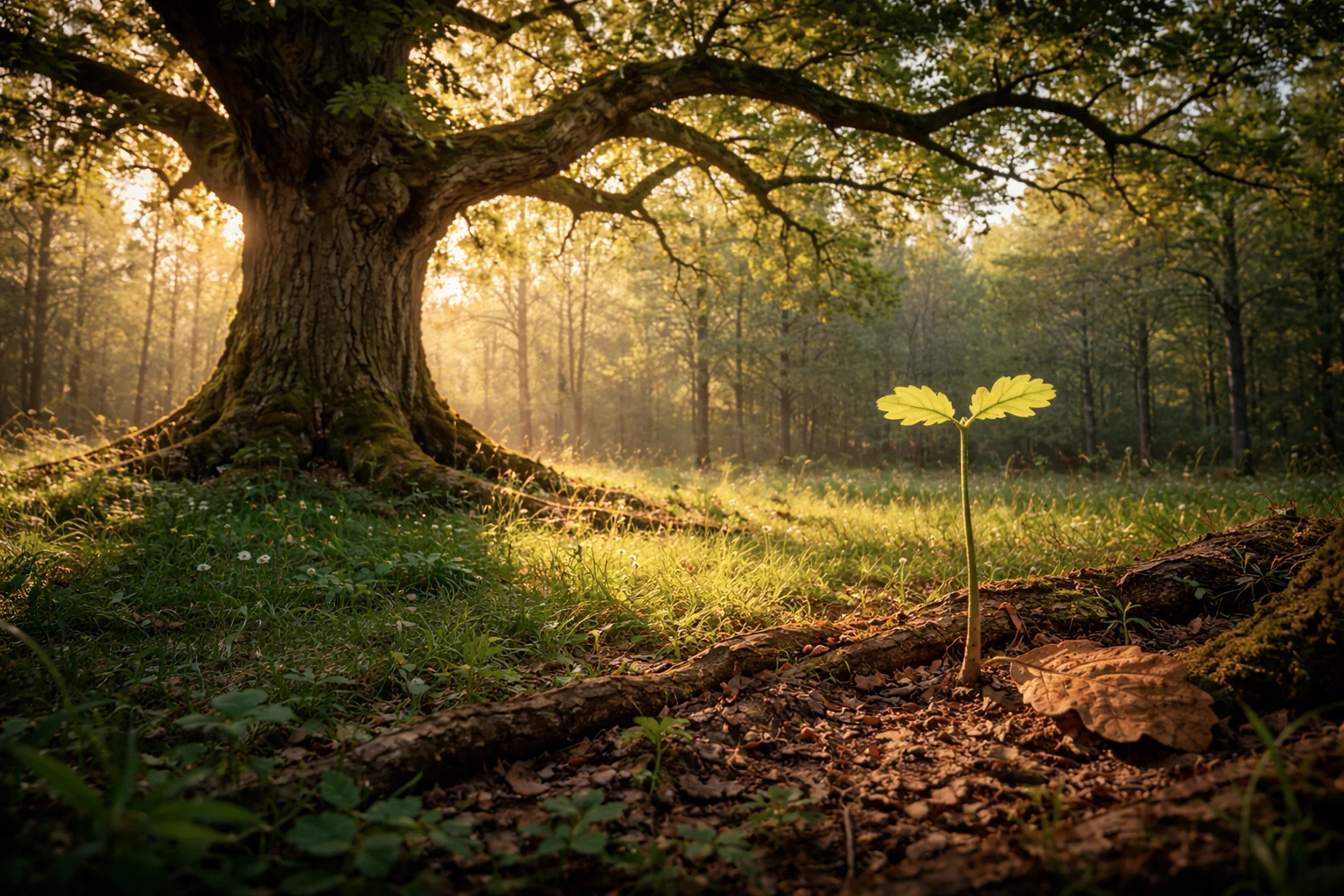
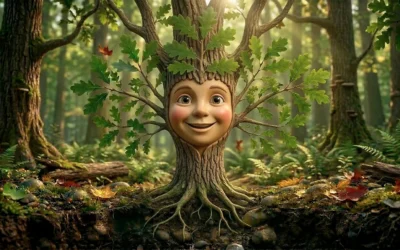
This story about a tree follows one small acorn through the long, dark wait between letting go and learning to grow.
The day Little Oak let go of his branch, he didn’t say goodbye.
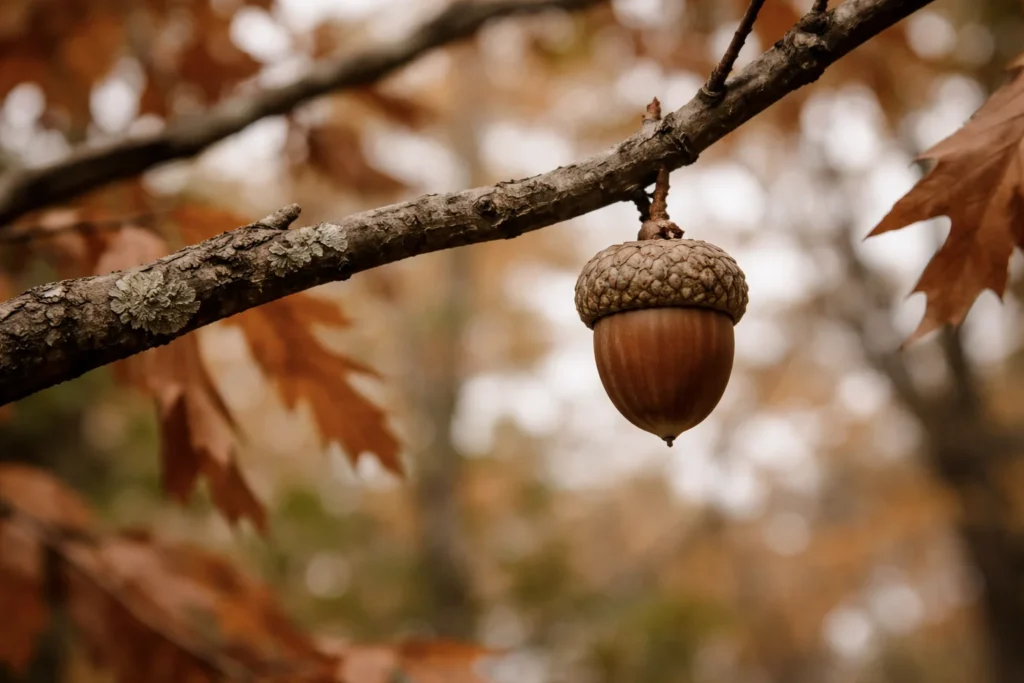
He’d been thinking about it all autumn, watching the older acorns drop one by one, listening to them whisper on the way down. Some whooped. Some laughed. Most said nothing at all. They just fell, the way things do when they’re ready, or when the wind decides for them.
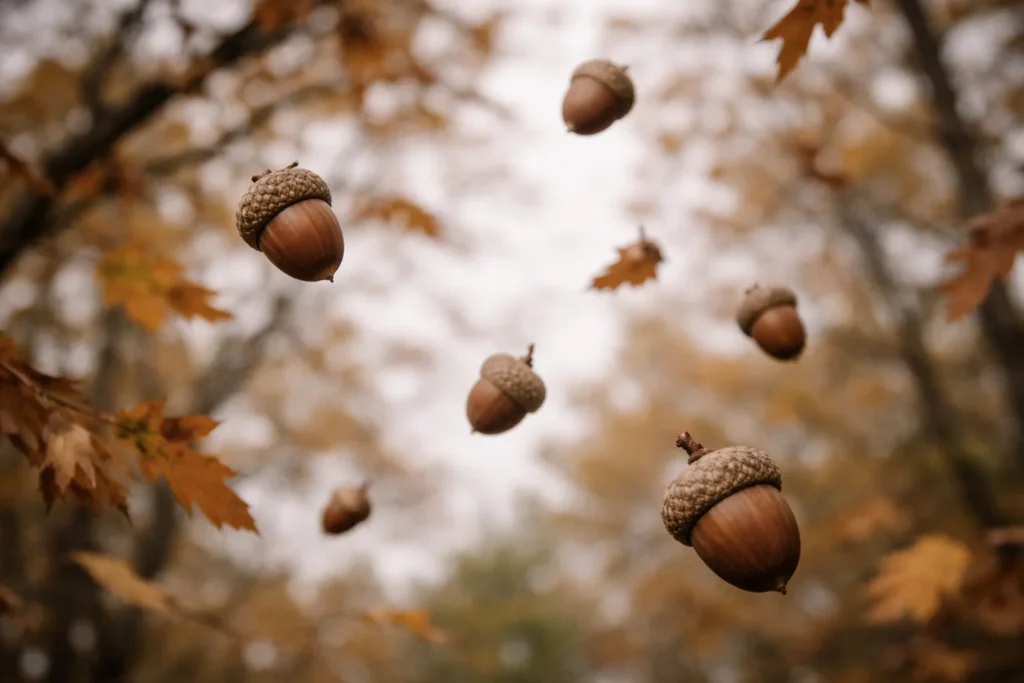
Little Oak wasn’t sure he was ready. But the branch had grown thin beneath his cap, and the Great Oak, his mother, his whole world, had begun her long autumn breath, drawing her warmth slowly inward the way all living things do when winter comes.
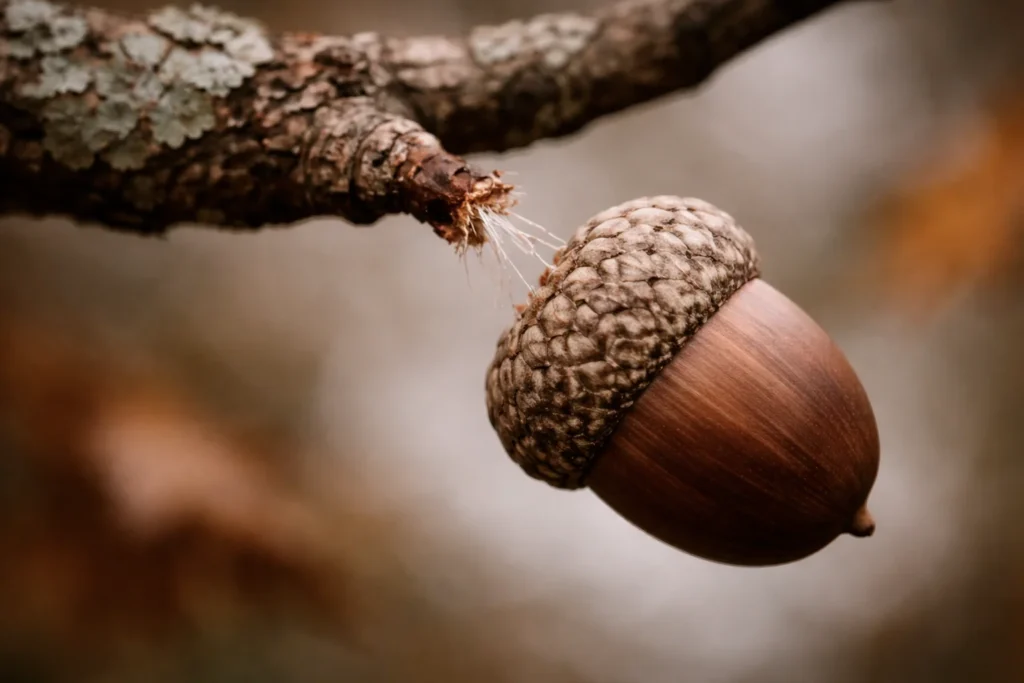
So he let go.
Snap.
The fall was faster than he expected. He clipped a mossy branch, spun twice, and hit the forest floor with a soft, undignified thump. For a moment he just lay there, staring up through the thinning canopy at the gray October sky.
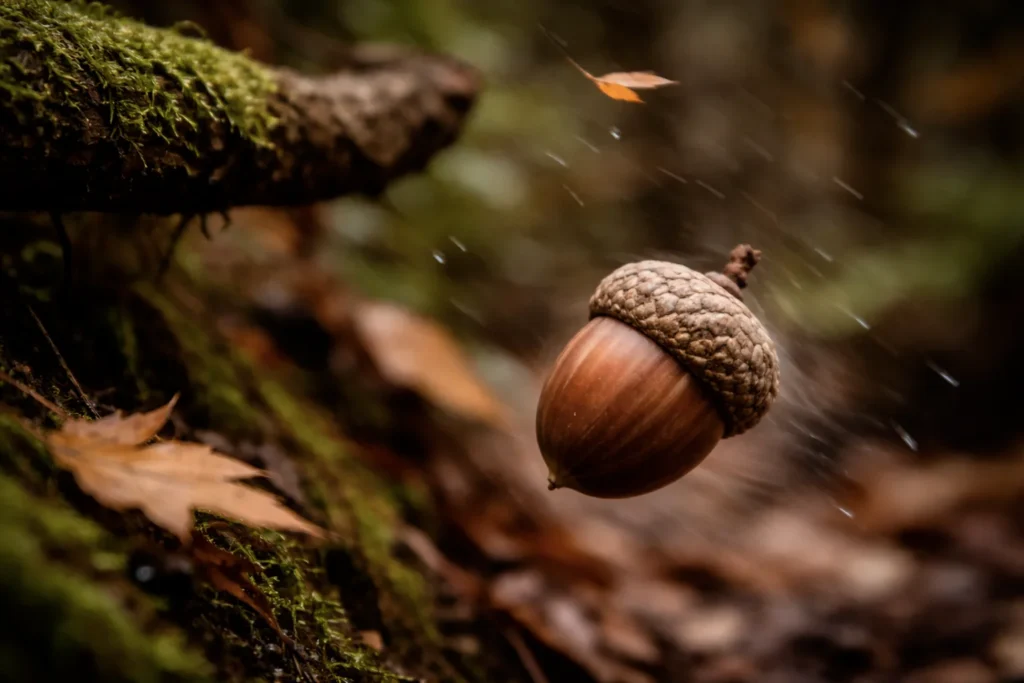
“Right,” he said to no one. “I am going to be a tree now.”
He wiggled around into the dirt, closed his eyes, and concentrated. He imagined roots bursting from his shell. He imagined a trunk shooting up through the leaf litter, branches unfurling like arms stretching after a long sleep. He pushed with everything he had.
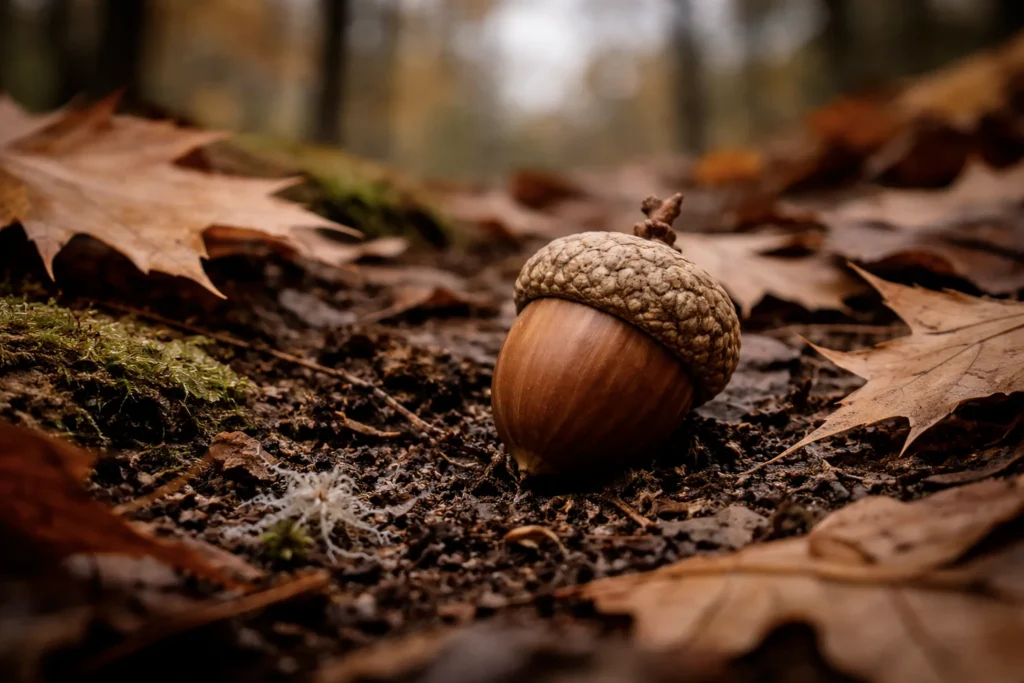
Nothing happened.
He opened one eye. A dry maple leaf drifted down and landed on his cap like a crooked hat.
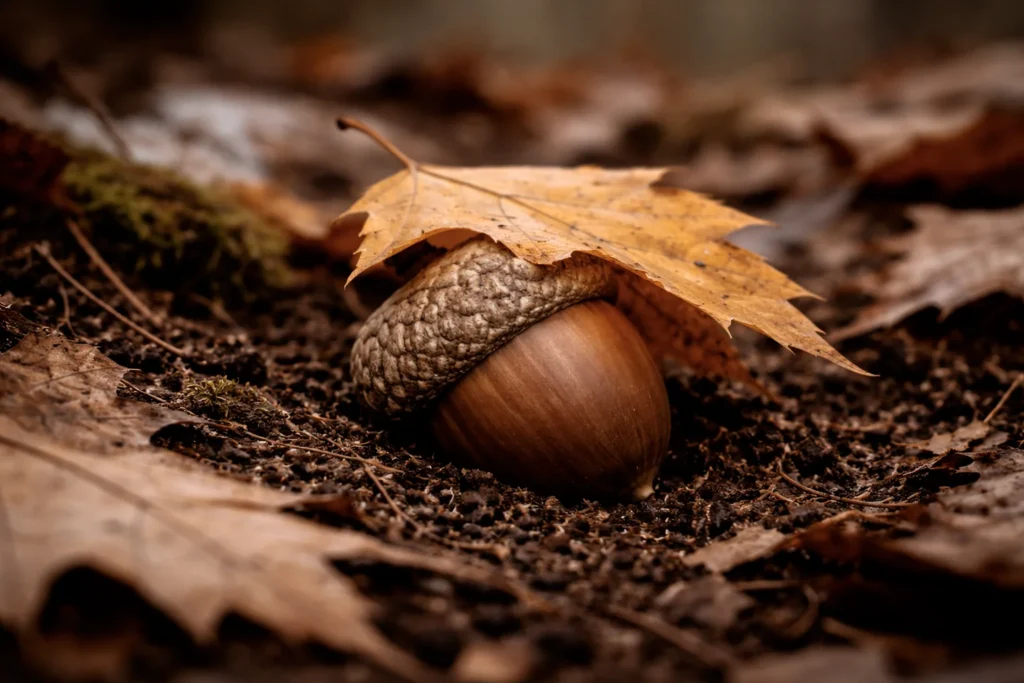
“Any minute now,” he muttered.
But minutes became hours, and hours became days, and the only thing that changed was the weather. The autumn rains came first, soaking the leaf litter into a dark, heavy paste. Then the frost. Then, one silent morning, the snow.
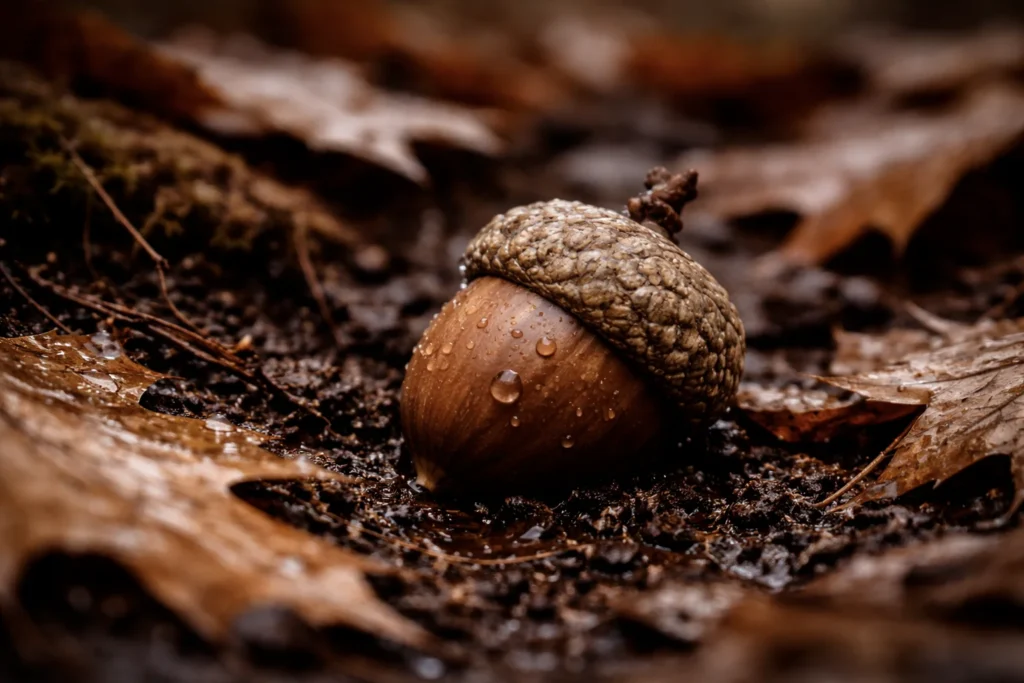
Little Oak had never felt cold like this. It crept into his shell, into the soft, pale meat of him, and sat there like a stone in a pocket. The snow piled higher. The world above disappeared. First the sky, then the branches, then even the faint gray light that filtered through the leaves.
He was alone in the dark.
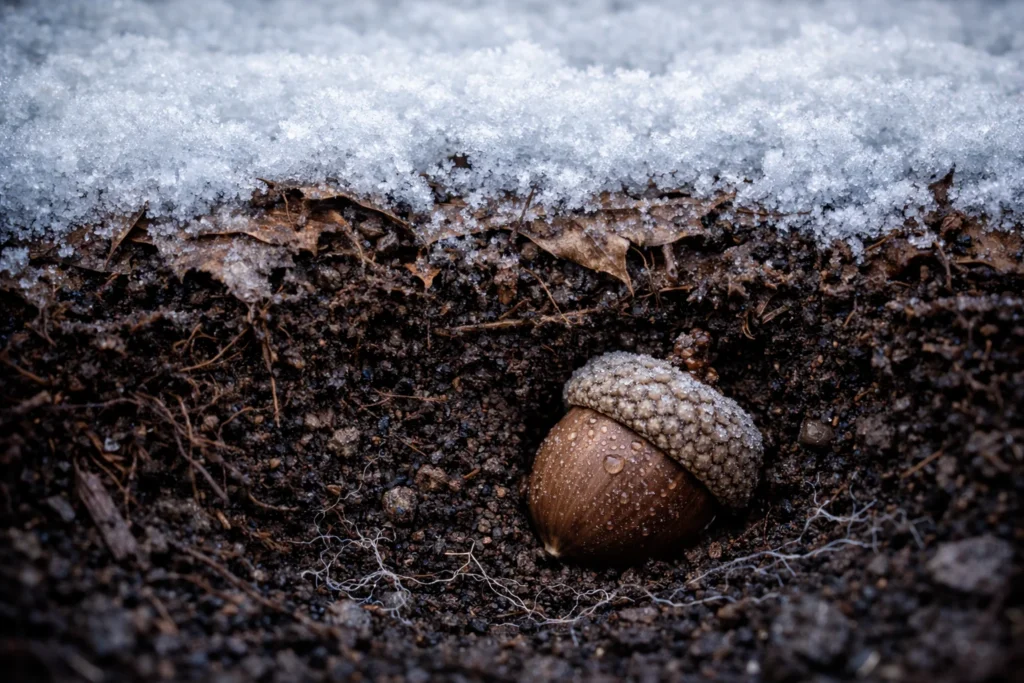
At first, he tried to stay brave. He told himself that this was part of it, the falling, the waiting, the cold. Every acorn went through this. But as the weeks dragged on and the weight of the frozen earth pressed tighter around him, brave started to feel like a word he’d borrowed from someone else and forgotten to return.
The mud came next. When the snow finally melted in late February, it didn’t free him. It covered him deeper. The meltwater rolled him down into a crack in the soil, and the silt sealed over him. He couldn’t wiggle. He couldn’t spin.
“I have been forgotten,” Little Oak whispered into the dark. The words tasted like wet clay. “The Great Oak dropped me, and the world covered me, and no one is coming.”
He believed it, too. That was the worst part. Not the cold, not the pressure, not the dark, but the growing certainty that he had been discarded. That he was not a seed at all.
He stopped trying.
Days passed. Or maybe weeks. Time doesn’t mean much when you can’t see the sun.
Then, one morning, or maybe it was evening, Little Oak heard something.
Scritch. Scratch. Scritch.
The sound was faint at first, like someone tapping a fingernail against a wall two rooms away. Then it grew louder, and the dirt near Little Oak’s left side began to crumble. A hole opened, barely wider than a thumb, and into it pushed a nose.
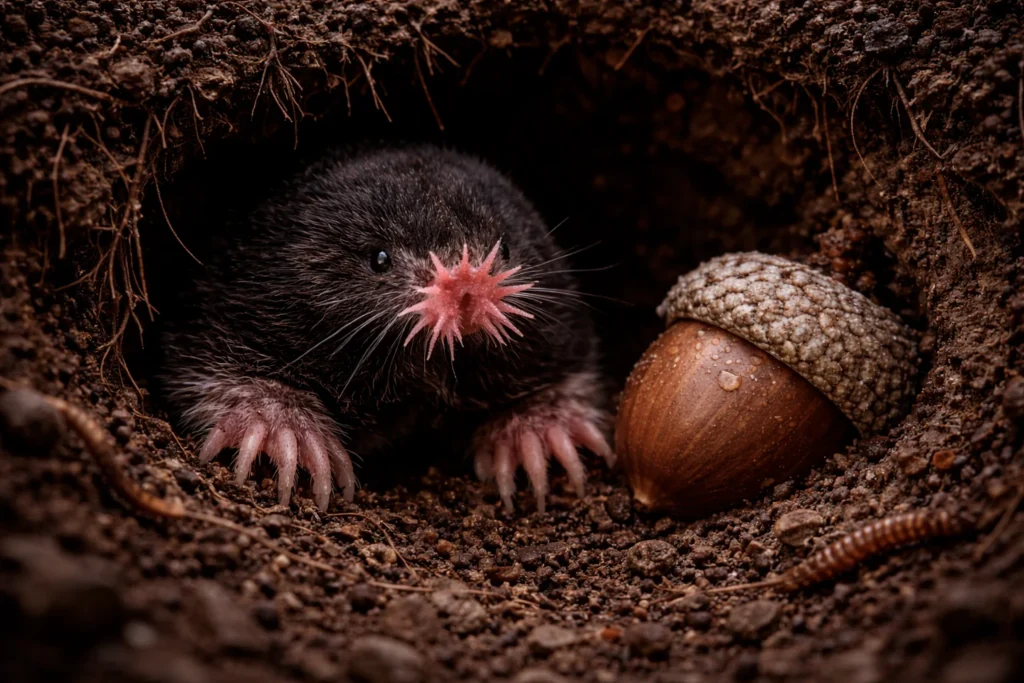
It was the strangest nose Little Oak had ever seen. Pink, wet, the nose twitched twice, sniffed hard, and then a voice came from somewhere behind it, low and rumbly, like a stone rolling downhill.
“You’re not a worm.”
“No,” said Little Oak.
“Pity,” said the voice. “I was hoping for a worm.”
The dirt crumbled further, and the rest of the creature pushed through: a Mole, squat and powerful, with enormous, clawed hands caked with soil. His eyes were tiny and clouded, nearly useless, but his nose trembled with an intelligence.
“You’re an acorn,” the Mole said, sniffing again. “A White Oak, if I’m not mistaken. Good year for your kind. I’ve been bumping into you lot all winter.” He began to turn back to his tunnel.
“Wait!” Little Oak cried. “Please, you have to dig me out. The earth is crushing me. I can’t move. I was supposed to become a tree, and instead I’m just stuck.”
The Mole stopped. He turned his nose back toward Little Oak and held it very still.
“Crushing you,” the Mole repeated. Not a question. A consideration.
“Yes. It’s heavy and dark, and it won’t stop pressing, and I think the world has forgotten I’m here.”
The Mole was quiet for a long time. When he finally spoke, his rumbly voice had gone soft. Not gentle, exactly, but careful. The way you speak when you’re telling someone something they’re not going to want to hear.
“Little Oak,” he said, “what do you think soil is?”
“Dirt,” Little Oak said. “Mud. The stuff that’s pressing in on me.”
“It’s a gathering place,” the Mole said simply. “Every leaf that ever fell from your mother’s branches is down here. Every acorn that came before you. Every beetle, every fungus, every scrap of bark the wind stripped away. They all came down here, and they all broke apart, and they became this.” He patted the wall of the tunnel with one heavy claw. “This isn’t waste, Little Oak. This is everything that ever lived in this forest, holding you.”
Little Oak said nothing.
“The weight you’re feeling,” the Mole continued, “that pressure on your shell, it isn’t punishment. It’s the necessary thing. If the earth wasn’t heavy, your shell would never crack. And if your shell never cracks…” He let the sentence hang there, unfinished, the way a teacher lets a student reach the answer on their own.
“The sun can never get in,” Little Oak whispered.
“Hm,” said the Mole. Which might have meant yes, or might have meant you’ll see, or might have meant nothing at all. Moles are not in the business of certainty.
He turned back to the tunnel. “I have worms to find,” he said. “Good luck with the tree business.” And he scritch-scratched away into the deep earth, the sound of his claws fading until there was only silence.
Little Oak was alone again.
The dark pressed in. The cold sat in his shell. The weight of the soil was exactly the same as it had been five minutes ago.
But it didn’t feel the same.
A gathering place, the Mole had said. Every leaf. Every acorn. Every living thing that came before him, broken down and pressed close, holding him in place. Not burying him. Holding him.
Little Oak thought about his mother, the Great Oak, two hundred years old, her roots running so deep that even the fiercest storms couldn’t pull her down. She had been an acorn once. She had been here, in this exact kind of dark, pressed in this exact kind of weight, and she had cracked open too.
He stopped fighting.
He let the mud be heavy. He let the dark be close. He let the pressure press against his shell without pressing back.
And in the stillness, in the deep, quiet beneath the forest floor, Little Oak felt something shift inside him. Below thought. Below decision. Something he had always known.
Pop.
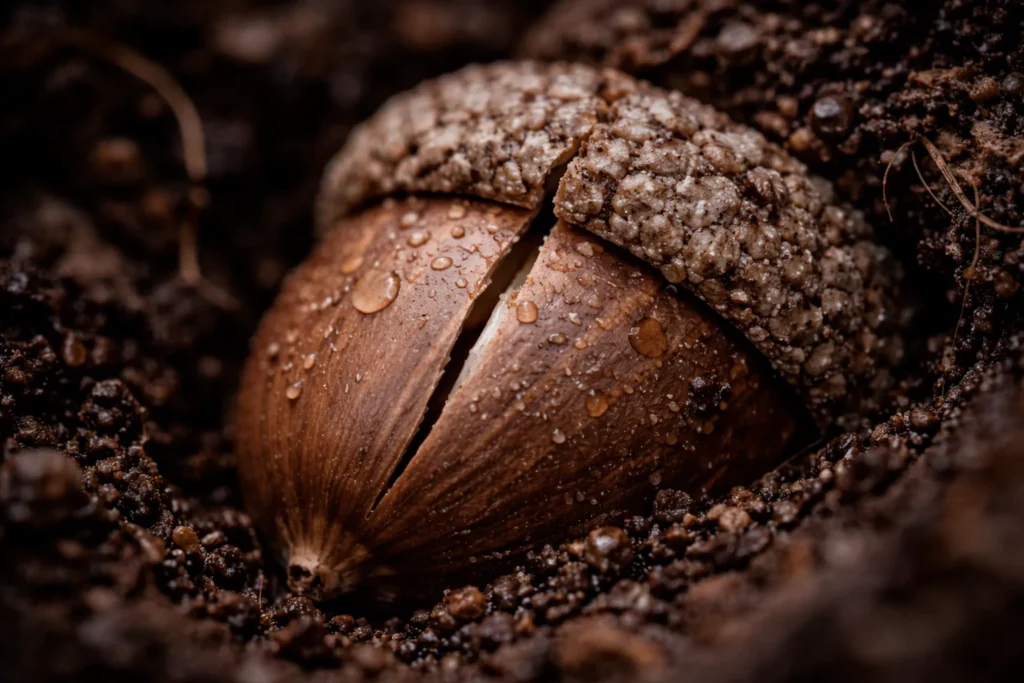
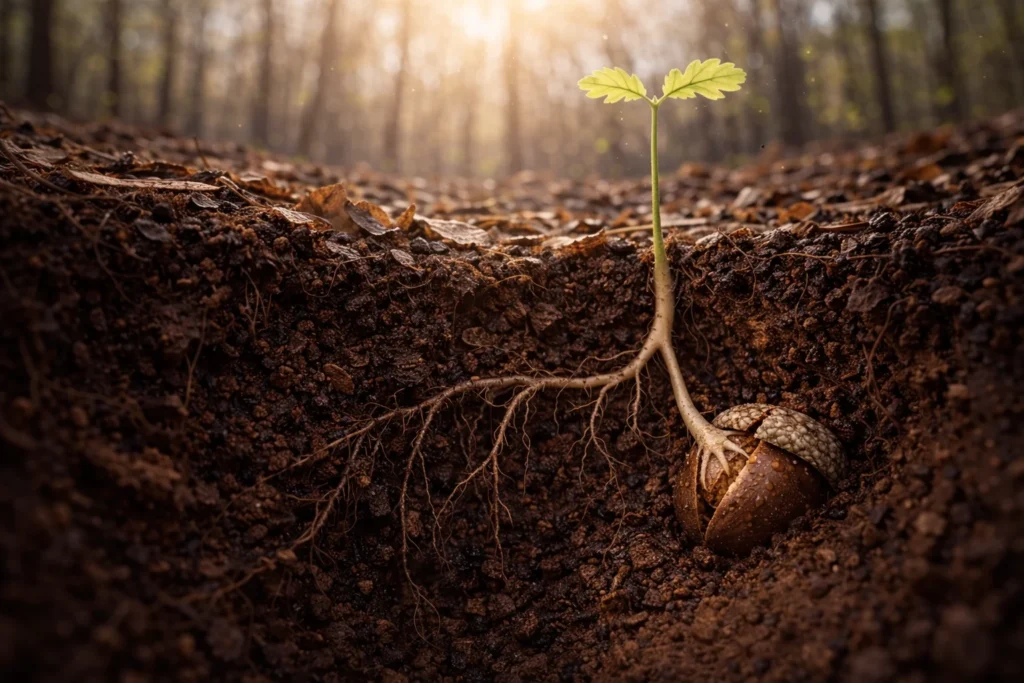
A hairline crack ran down the side of his shell. It didn’t hurt. It felt like stretching after a long, long sleep. And through the crack, warm and alive and reaching, came the first pale thread of a root.
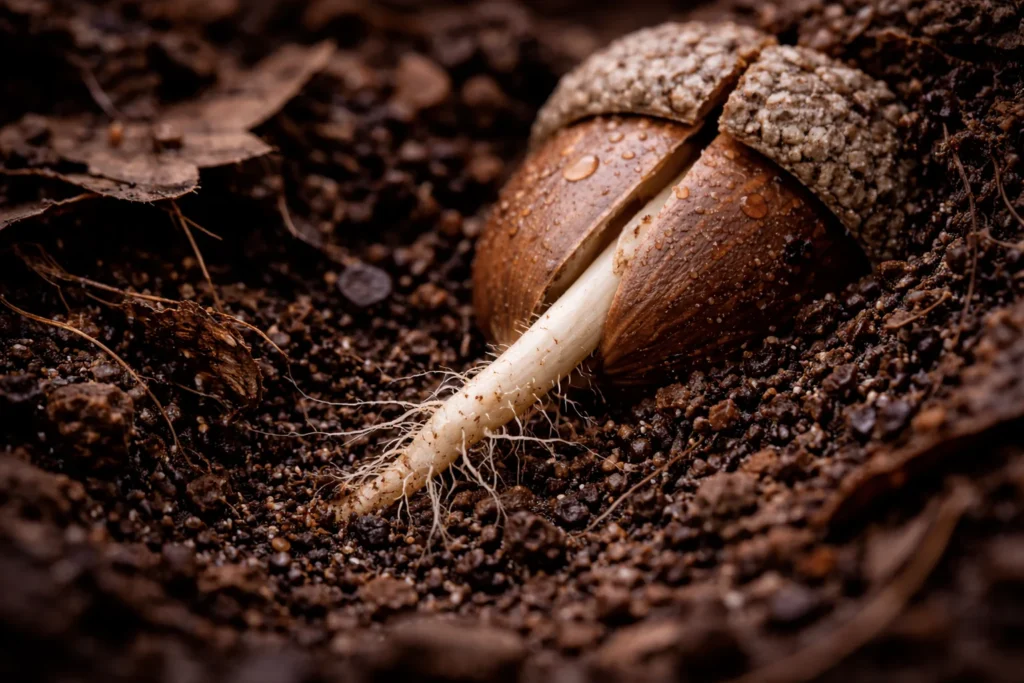
It pushed into the dark soil, into the gathered warmth of every leaf and acorn that came before, and it held on.
Above, the March sun was warming the forest floor. Little Oak couldn’t feel it yet. But the root could. And deep in his cracked-open center, curled like a secret, a shoot was waiting.
No hurry now. Some things grow best in the dark.
The End

0 Comments