
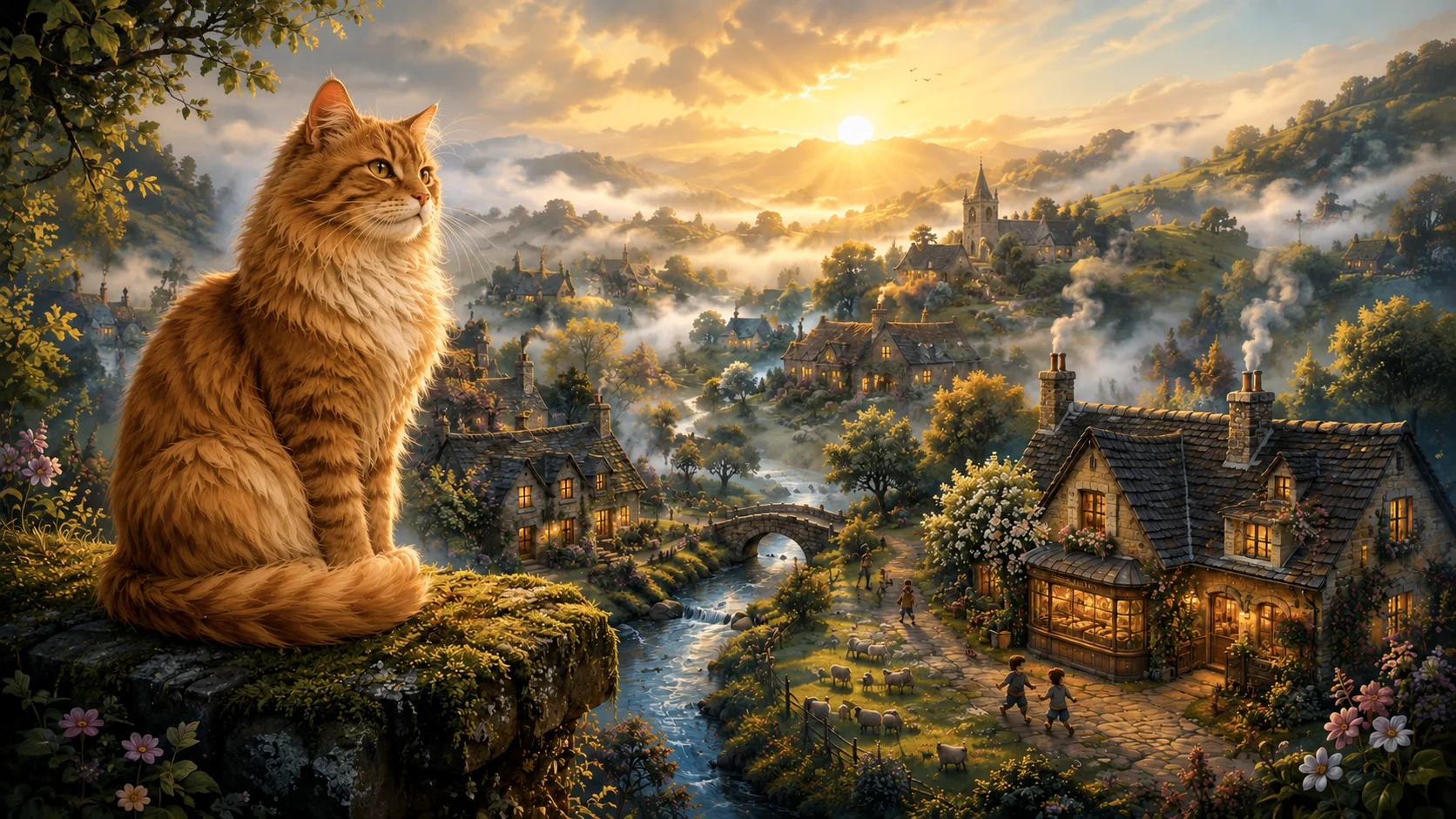
In this tender story of a cat, Alistair remembers every day in a valley where everyone else forgets. A quiet encounter with the baker helps him see his unusual burden in a gentler light.
The cat’s name was Alistair Fergus Brambleworth the Third.
No one in the valley knew this.
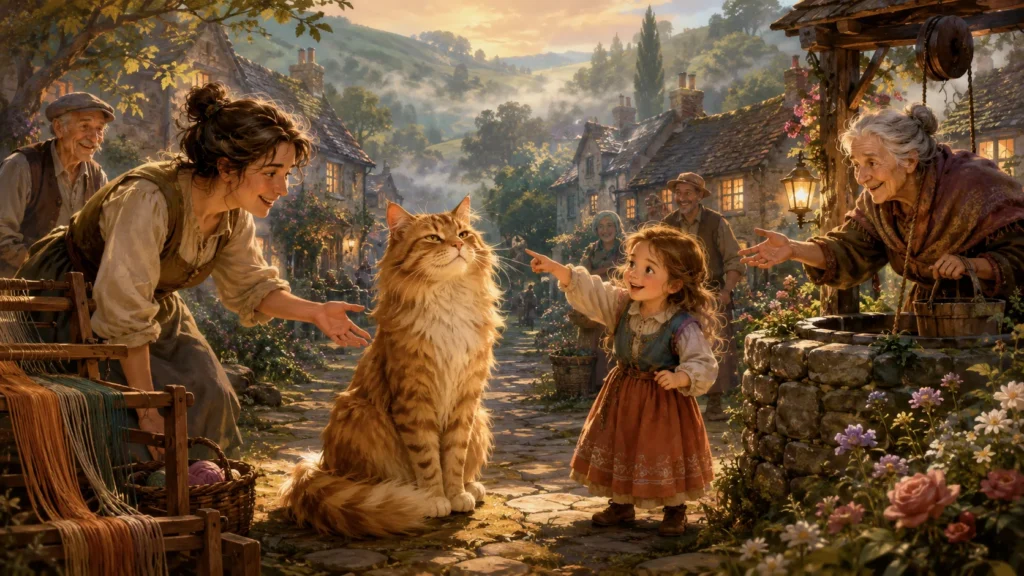
On Monday, the weaver called him Dusty. On Tuesday, the cooper’s daughter called him Lord Pumpkin. On Wednesday, the old woman by the well called him “Here, cat,” which was not a name at all, and Alistair Fergus Brambleworth the Third felt this deeply.
He had stopped correcting them four hundred days ago. He remembered the exact day. He remembered everything.
That was his problem.
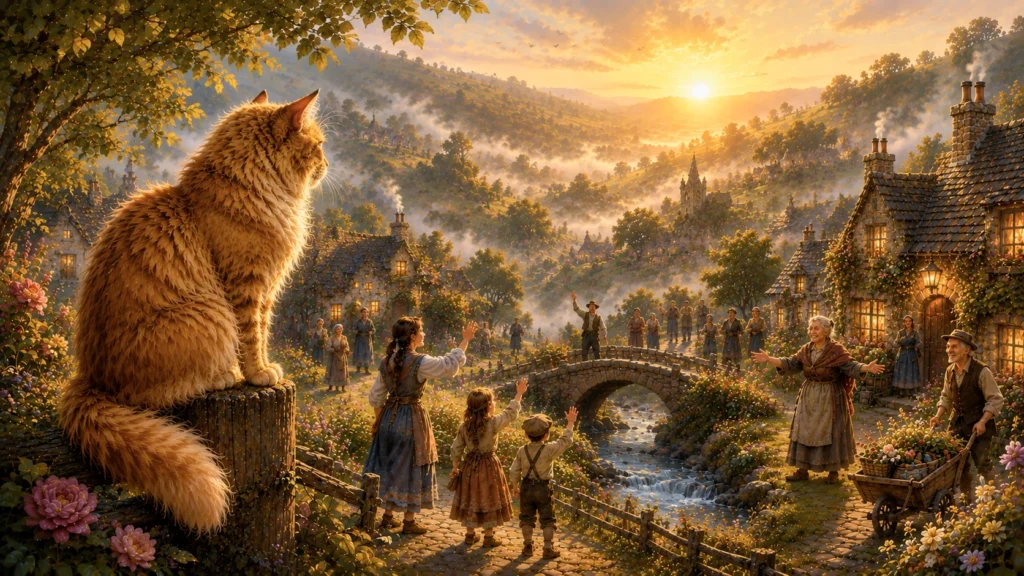
The valley, you see, was wrapped in a soft silver mist, and the mist made everyone forget just a little each day. The people of the valley did not mind this, because they could not remember that there was anything to mind.
Alistair minded enormously.
He minded when the blacksmith greeted him each morning as though they had never met. He minded when the children petted him with great excitement, shouting “Look! A cat!” as if he had not been sitting on that same fence post for six years. He minded when the goatherd offered him milk and said, “I wonder if cats like milk,” and Alistair had to resist the urge to knock the bowl over with his paw, though, to be fair, he did not always resist.
He especially minded the baker.
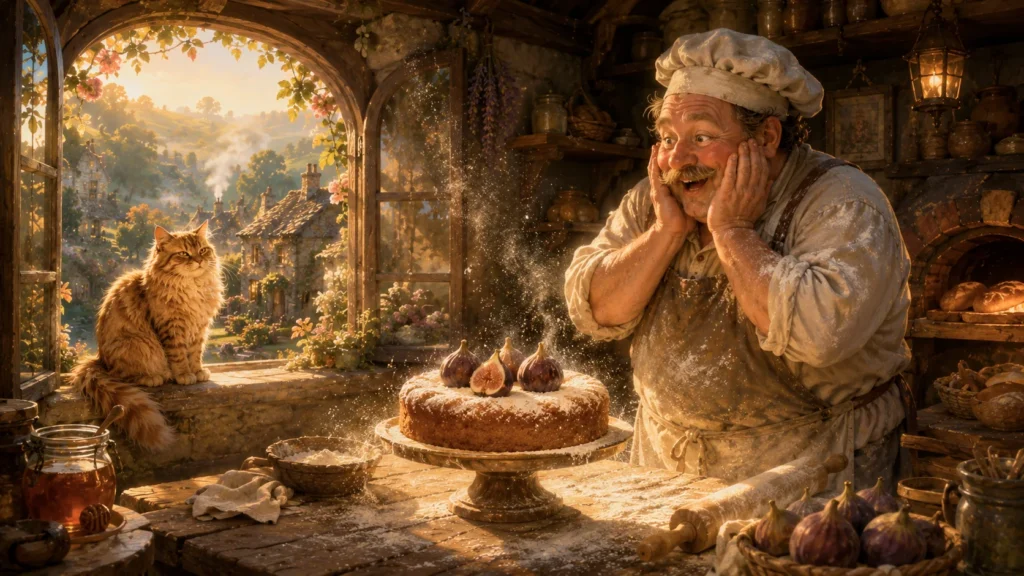
The baker was a round, flour-dusted man named Gethin, and every single morning, Gethin baked a honey cake.
The same honey cake.
With the same four figs on top, arranged in the same lopsided way, dusted with the same cinnamon, cooled on the same rack by the same window.
And every single morning, Gethin stepped back, looked at the cake, pressed his floury hands to his cheeks, and said, with the genuine, wobbling wonder of a man seeing a sunrise for the first time, ”Would you look at that.”
Alistair, sitting on the windowsill, looked at that.
He had looked at that yesterday. And the day before. And the day before that. Three hundred and twelve days of the same cake, the same four figs, the same astonished face.
“I’ve outdone myself,” Gethin whispered.
Alistair closed his eyes. He thought about the indignity of being a creature with a perfect memory in a world made of fog.
“Magnificent,” Gethin said, cutting a slice. He offered a crumb to the cat. “Here you go, little fellow. Do you like cake? I wonder if cats like cake.”
Alistair ate the crumb. It was good cake. It had been good cake yesterday too.
The afternoons were worse.
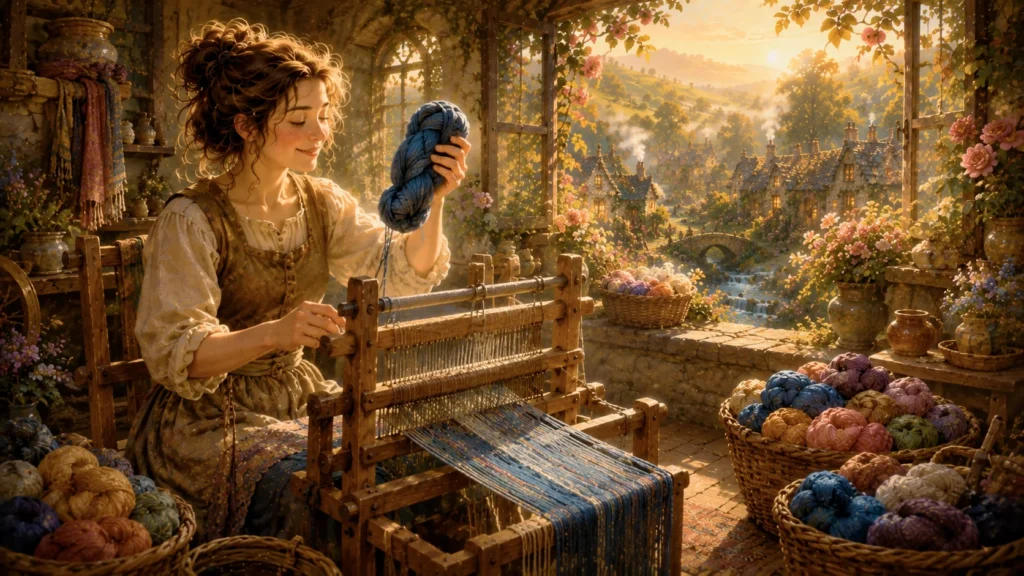
The weaver would start the same scarf she had started the day before, choosing the same blue wool, holding it up to the same window, and saying, “I have a feeling about this color.” She had the same feeling every day. The feeling was blue.
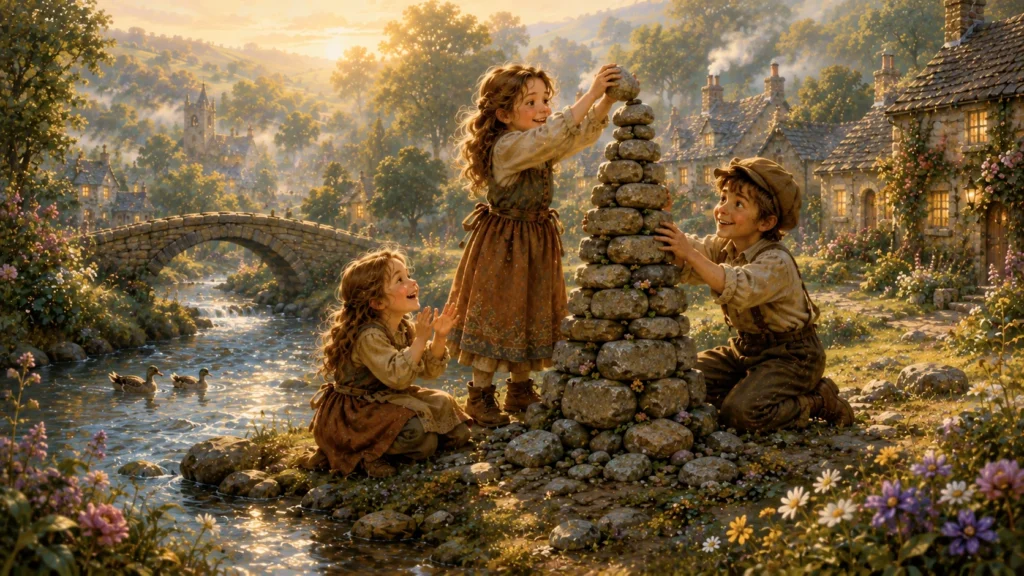
The children would build the same crooked tower of stones by the river, forget who had built it, discover it the next morning, and shout, “Who made this? It’s brilliant!” They had made it. It was always them.
And the old couple on the stone by the water, Alistair watched them too. The woman leaned into the man’s shoulder. The man held her hand.
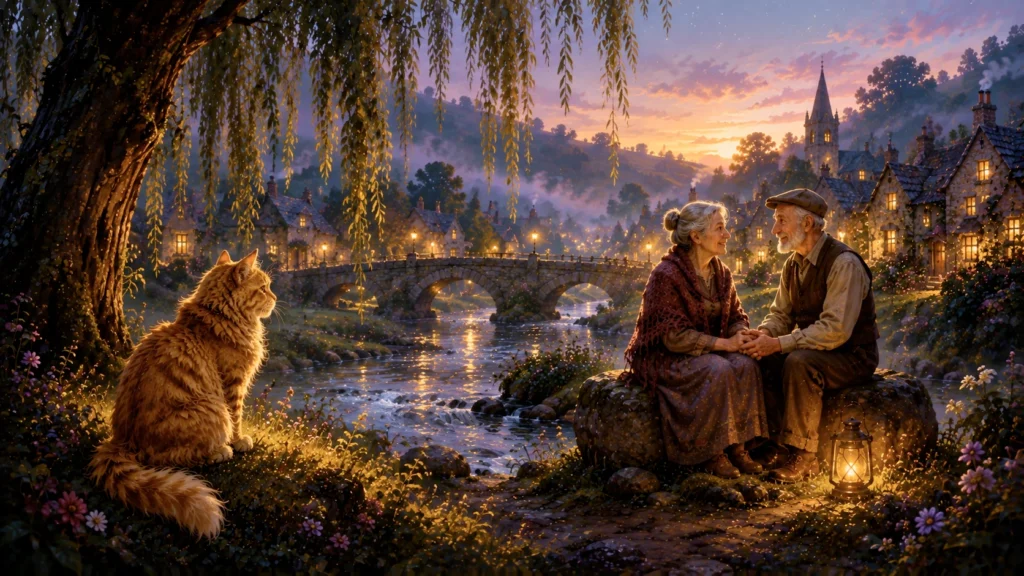
They had the same conversation each evening, something about a song and a shadow and a mist, and each time they spoke the words as though the words were new.
Alistair knew the words were not new. He had heard them all. He remembered every version of every conversation the valley had ever had with itself.
This was, he had decided, the loneliest thing in the world: to be the only one who knew the previous chapter.
Some evenings, when the mist thickened and the light went grey as wool, Alistair walked to the edge of the valley and sat on the highest stone he could find.
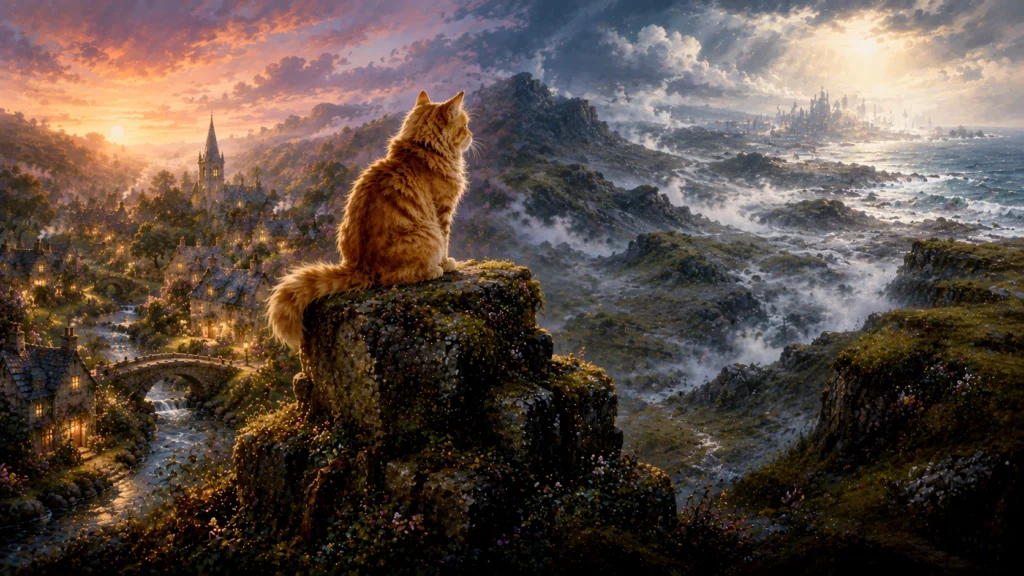
He could feel the mist moving around him, warm, soft, smelling faintly of earth and sleep.
He had tried, once, to leave. He had walked three hills in the direction of anywhere else. The air had grown sharp. The colors had grown loud. A bird had shrieked at him with a sound like a door hinge, and he had turned around and come back to the valley before nightfall.
The truth, and he would never say this aloud, because he was a cat and cats do not make admissions, was that the valley, for all its maddening repetition, was gentle. The people were kind. The milk was warm. The baker’s cake, however familiar, was always good.
And Alistair remembered that too: every kindness, every warm bowl, every child’s hand on his back, every soft word spoken to him under a name that was not his.
He remembered all of it, stacked up inside him like a tower of days.
One night, the baker could not sleep.
This happened sometimes. Even the mist could not settle every restless thing. Gethin came out to his shop in his nightclothes, lit a candle, and sat at the flour-dusted table.
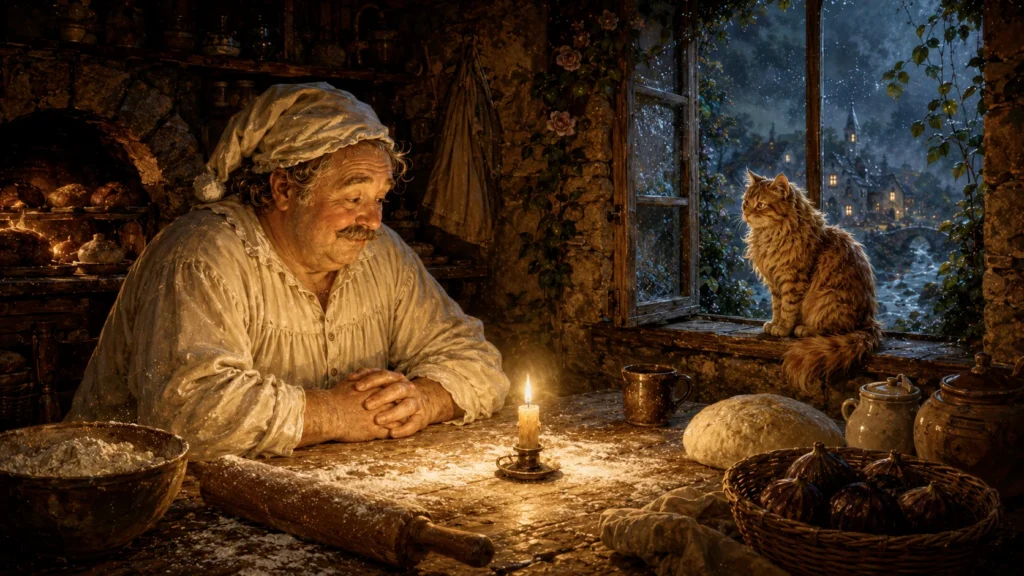
Alistair was already there. He was always already there. The windowsill was his, though no one remembered this arrangement except him.
“Oh,” Gethin said softly. “Hello, cat.”
Alistair looked at him.
“Can’t sleep either?” Gethin asked. He reached out and scratched behind Alistair’s ear — gently, in the right spot, the way he did every time, though he never remembered having done it before.
Alistair, despite himself, purred.
They sat in the dark shop. The candle flickered. Flour hung in the air like tiny stars. The mist pressed against the window, soft and silver.
“I had a feeling today,” Gethin said quietly. He was not looking at the cat. He was looking at the rack where the cake had cooled. “When I finished the cake. I had this feeling that I had made it before. Many times.” He paused. “Isn’t that strange? It felt like… I had been happy about that cake a hundred times.”
Alistair went very still.
“I can’t remember,” Gethin said. “But the feeling is there. Like the shape of something in the fog.”
He looked at the cat. The cat looked at him. For a long, quiet moment, neither moved.
“I’m glad you’re here,” Gethin said. “I feel like you’re always here. Even if I can’t.” He stopped. He scratched behind Alistair’s ear again. “What’s your name, I wonder?”
The candle guttered. The mist curled. Alistair Fergus Brambleworth the Third closed his eyes and leaned into the baker’s warm, floury hand.
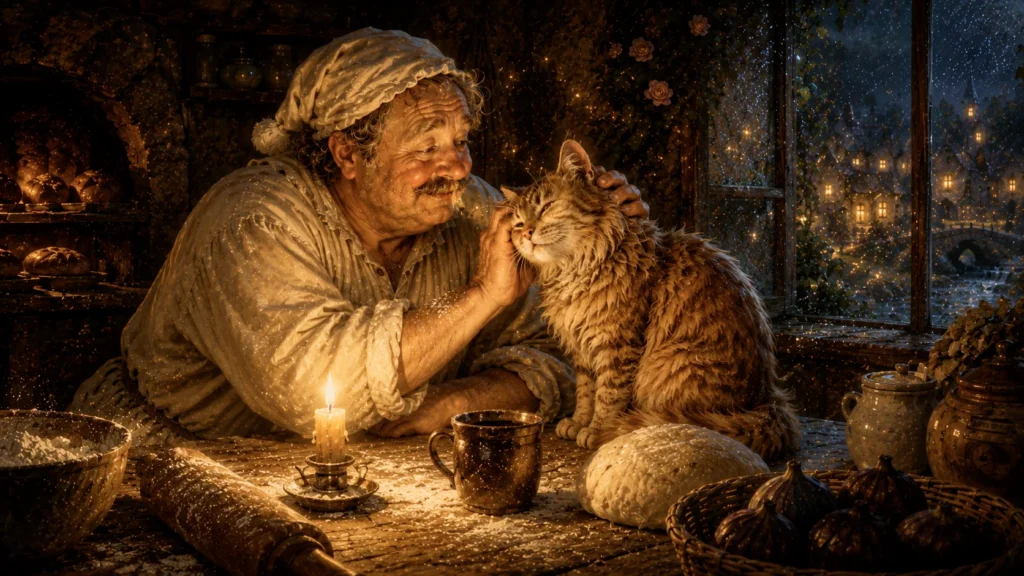
He did not say his name. The baker would only forget it by morning.
But the leaning, the leaning, he let himself keep.
Outside, the valley breathed. The mist held its grey blanket close. Somewhere, a woman hummed three notes she could not place, and an old man listened as though hearing them for the first time.
The baker blew out the candle and went back to bed. In the morning, he would bake a honey cake, and it would astonish him.
Alistair curled on the windowsill, tucked his nose under his tail, and let the mist do what it did. He would remember this night. He would remember all the nights.
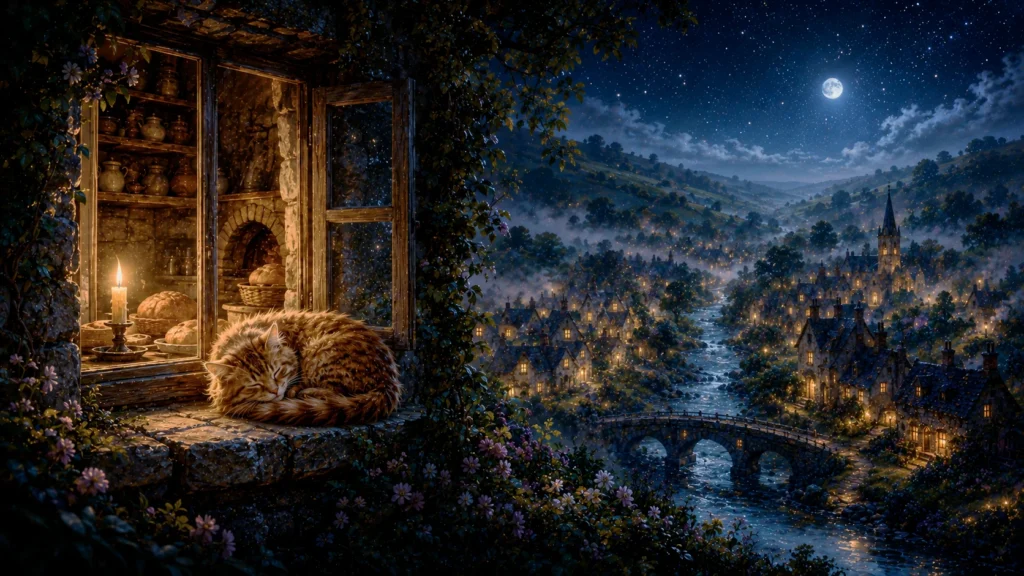
That was his burden, and it was his gift, and in the grey, gentle dark, they were the same thing.